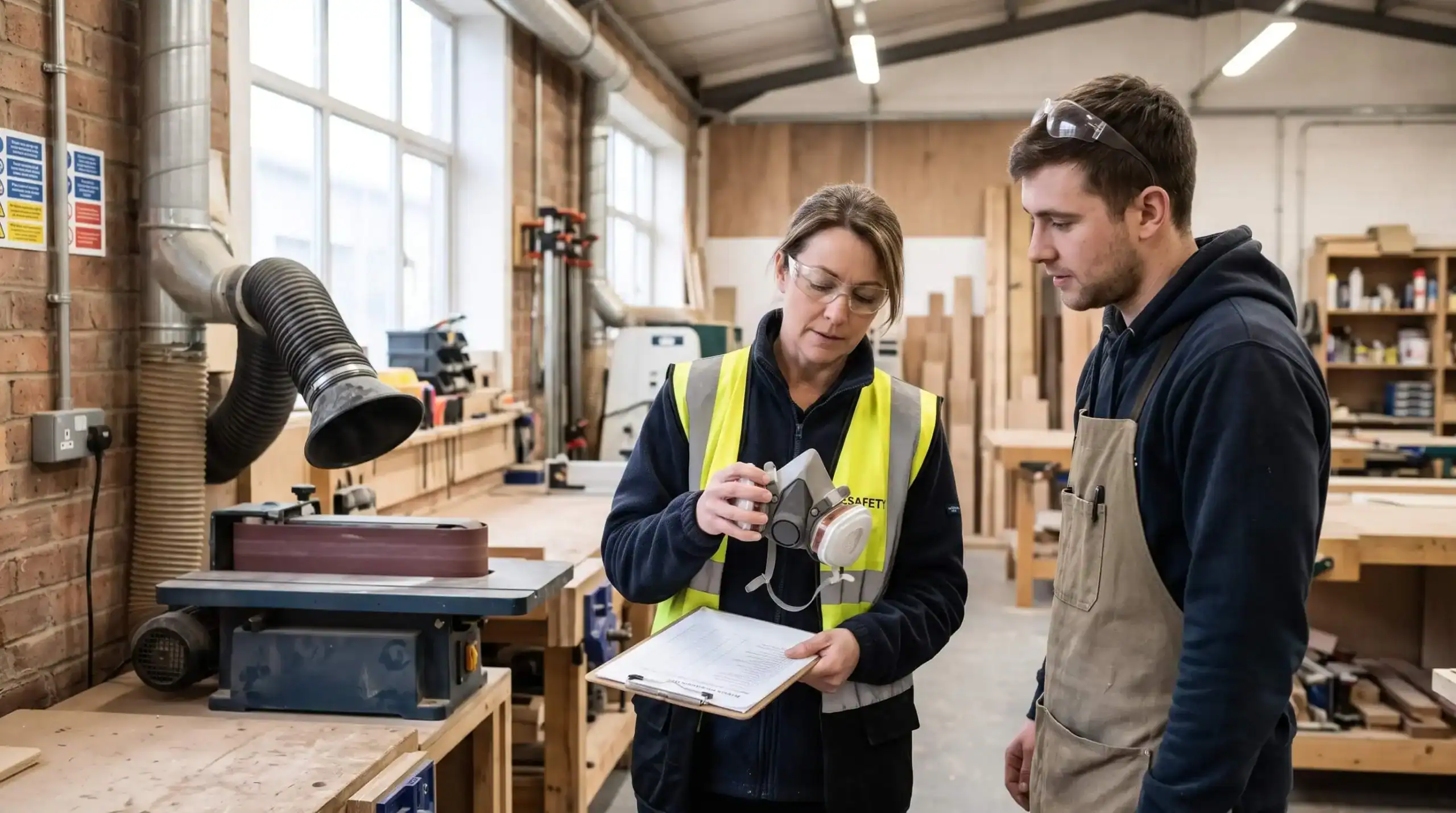
Respiratory protective equipment (RPE) protects workers by filtering contaminated air or supplying breathing-quality air. Employers should select it through an assessment of the airborne hazard, exposure level, wearer and task (HSE, 2013b).
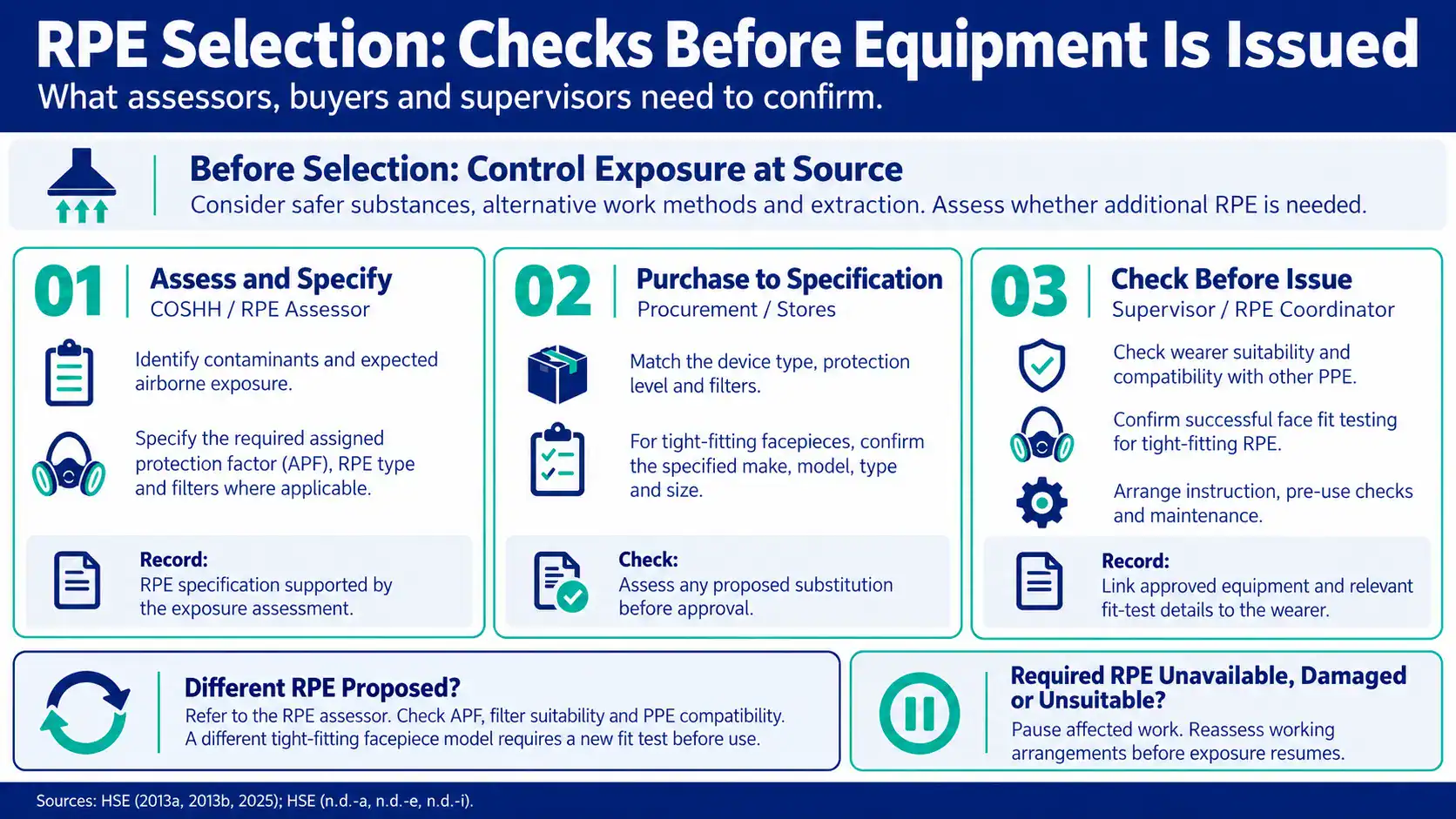
That assessment begins before equipment is ordered. First establish whether a safer product, different work method or extraction can adequately control exposure. Where RPE is still needed, buyers and supervisors need a specification that identifies the equipment and protection required for the work.
On 9 December 2020, a 38-year-old maintenance worker was laying a vinyl bathroom floor. His employer had purchased an adhesive containing dichloromethane (DCM), a solvent that releases large amounts of vapour even at room temperature.
A damaged hose on the pressurised canister released adhesive into the poorly ventilated bathroom. The worker inhaled toxic vapour, lost consciousness and collapsed. He died from the exposure (HSE, 2026 ).
HSE found that the employer had failed to take appropriate precautions to avoid hazardous substances where safer alternatives were available. The company pleaded guilty to breaching its duty to protect employees and was fined £400,000 in January 2026 (HSE, 2026).
The published account does not identify a particular mask or filter failure. Its findings reinforce why employers must assess the product and work method before deciding what additional respiratory protection is required.
Before specifying RPE, assess whether changing the product or work method, or improving extraction, could adequately control the worker’s exposure.
In Great Britain, the Control of Substances Hazardous to Health Regulations 2002 (COSHH) require employers to prevent exposure or, where that is not reasonably practicable, control it adequately. Regulation 7 gives priority to engineering and source controls, with suitable PPE added where other measures cannot achieve adequate control (HSE, 2013a).
Northern Ireland has separate corresponding legislation (Department of Health, n.d.). Asbestos and lead are covered by separate regulations (HSE, n.d.‑g).
RPE may supplement extraction where airborne exposure remains or provide interim protection while further controls are installed. For short or infrequent work, the assessment should explain why other reasonably practicable controls are insufficient or impractical. A job being brief does not, by itself, justify relying on RPE (HSE, n.d.‑j).
Emergency work, escape and rescue require specialist arrangements beyond routine selection. For routine work, establish which airborne contaminants remain after existing controls and the level of respiratory protection needed for that exposure.
Once the assessment identifies a need for RPE, the equipment has to meet two tests.
Adequate RPE provides enough protection against the hazard and level of exposure. Suitable RPE also works for the wearer, task and environment, without creating additional risks or unnecessarily obstructing the job (HSE, n.d.‑a).
Particle filters capture airborne particles such as dust and fume. They do not protect against gases or vapours. Gas and vapour filters must match the substances present, with combined filters needed where both particle and gas or vapour protection are required (HSE, n.d.‑a).
For DCM, an instruction simply to wear a respirator leaves the buyer unable to judge whether filtering equipment can provide adequate protection against the vapour. HSE’s separate solvent guidance explains that DCM can pass through respirator filters rapidly. Constant-flow airline breathing apparatus is normally needed, with limited exceptions for very short tasks where AX filters may be adequate (HSE, n.d.‑c).
A respirator filters the surrounding air. Breathing apparatus supplies breathing-quality air from an independent source. A powered filtering hood still relies on surrounding air and the correct filters (HSE, n.d.‑h).
Filtering equipment does not supply oxygen. Where oxygen levels are uncertain or deficiency is suspected, seek specialist assessment. Buying a higher-rated filter cannot make that atmosphere safe (HSE, n.d.‑h).
The RPE specification should identify the required device type and protection level, together with the appropriate filter where a filtering respirator is suitable.
The assessor should provide procurement with the required protection level, device type, filter configuration where applicable and any wearer-specific requirements before an order is placed. Work through the following decisions in order.
Identify each part of the task that could release airborne contaminants, including normal operations, cleaning and maintenance. Check what the process generates as well as the products supplied. Sanding can produce wood dust and welding can produce fume without a labelled chemical container being involved (HSE, n.d.‑g).
Use the safety data sheet (SDS) to identify the hazards and precautions, then assess the expected airborne exposure against relevant workplace exposure limits (WELs) and the effectiveness of existing controls. The SDS supports the assessment; it does not replace it (HSE, n.d.‑b).
A safety data sheet that recommends suitable RPE still requires a task-specific exposure assessment before the necessary protection level can be established. For solvent application, consider how much product is used, whether ventilation removes vapour from the breathing zone and how long the worker remains near the source.
Check relevant COSHH Essentials task guidance. If the available information cannot support a choice, obtain competent advice on the assessment or measurements needed before specifying equipment (HSE, n.d.‑f).
The assigned protection factor (APF) describes the exposure reduction a type and class of RPE can provide when properly selected and used. For example, an APF of 10 indicates that properly selected and used RPE can reduce the concentration breathed in to one-tenth or less of the concentration outside the device. Establish the required APF through applicable task guidance or competent assessment (HSE, 2013b).
Cole, Whitelaw and Driscoll (2026) reviewed occupational hygiene exposure assessments from six Australian tunnelling projects covering 2018 to 2024. They examined circumstances in which measured silica exposure exceeded the applicable exposure limit.
Where occupational hygienists judged RPE inadequate, the most frequently identified factor was equipment with insufficient protection for the exposure. Workers could be wearing the RPE provided and still receive too little protection (Cole et al., 2026).
This was retrospective Australian research based on hygienists’ recorded assessments. The findings cannot establish how frequently RPE selection fails in UK workplaces. They support a specific purchasing check: compare the selected device’s protection factor with the level required by the exposure assessment before issue. Telling someone to wear their mask cannot correct an inadequate equipment specification.
Exposure below a WEL can still require further reduction. For carcinogens, mutagens and substances causing occupational asthma, exposure must also be reduced as low as reasonably practicable (HSE, 2013a).
Ask workers how the proposed RPE affects breathing effort, heat, visibility and communication during the task, particularly where it must be worn for long periods. Check whether the RPE works with the required eye, head and hearing protection. Seek appropriate medical advice where health concerns could affect its use (HSE, 2013b; HSE, n.d.‑d).
Ask wearers about practical difficulties before settling the choice. If the proposed RPE restricts vision, interferes with communication or cannot be worn for the required period, reassess the device or working method before issue.
Each tight-fitting facepiece needs face fit testing for its wearer. Issue the same make, model, type and size of facepiece used in the wearer’s successful fit test (HSE, n.d.‑e).
Identify the equipment, filters, tasks and wearers covered. Set out instruction, checks, filter replacement, maintenance and storage arrangements, following manufacturer instructions. Identify who issues the approved RPE, arranges filter replacement and maintenance, and checks that equipment remains suitable for use (HSE, n.d.‑i).
The following table can support the handover from assessor to buyer and supervisor. It is a practical management aid, rather than a statutory approval form.
A record saying only “half mask” gives the buyer too little to work with. Record the exact facepiece make, model, type and size, together with the approved filter configuration, so procurement and stores can identify an unassessed substitution.
For a tight-fitting facepiece, selection includes checking the seal on the individual wearer. A competent tester should carry out that fit test. If the person uses different types of tight-fitting facepiece, each needs testing (HSE, n.d.‑e).
Face fit testing establishes whether a particular facepiece seals adequately on the wearer. The exposure assessment determines which contaminants require protection and the appropriate filter and protection level (HSE, 2013b; HSE, 2025).
Where facial hair prevents an effective seal, consider a suitable loose-fitting powered hood or breathing apparatus configuration that provides the required protection. Loose-fitting hoods and helmets do not rely on that facial seal and do not require face fit testing, although protection and task suitability still need checking (HSE, n.d.‑e, n.d.‑h).
A fit check happens whenever the wearer puts on the facepiece. Before entering the hazardous area, the wearer should complete the manufacturer’s seal check each time the tight-fitting facepiece is put on. The check does not replace the fit test (HSE, 2025).
The records serve different purposes too. An awareness course certificate records course completion. A wearer’s fit-test report records the test of a particular facepiece on that person. Training someone to conduct tests addresses another role and does not, alone, establish tester competence.
After a successful fit test, link the result to the worker and approved facepiece in the issue records. Review changes to the facepiece or wearer that could affect the seal.
Review the RPE selection when the substance, process, exposure, work rate or wear duration changes. Also review it when wearers report difficulty using the RPE, a fit test fails or maintenance identifies a defect (HSE, n.d.‑g).
Suppose the specified respirator is unavailable and a supplier offers another model with a similar protection class. Ask the person responsible for RPE selection to assess the replacement before approving it for use.
Before accepting a substitute, have the RPE assessor check its protection factor, filter suitability, compatibility with other PPE and any additional face fit testing needed for the wearer. A different tight-fitting model also needs fit testing. A change of substance may require different filters without changing the facepiece; that review does not automatically require another fit test (HSE, 2025).
Repeat testing is needed where changes to the facepiece or wearer could affect fit, including relevant changes to other head-worn PPE (HSE, 2025).
In the flooring incident, the employer purchased a DCM-containing adhesive despite the availability of safer alternatives. Procurement decisions involving hazardous products therefore need input from the COSHH assessment before approval. Before approving a new hazardous product, assess the exposure it could create and whether a safer alternative is available. For substitute RPE, confirm that its protection level and suitability meet the existing assessment. Give supervisors the approved RPE specification. Identify who is authorised to assess proposed changes to hazardous products or respiratory protection and who can approve their use.
Human Focus respiratory protective equipment training covers RPE types, factors affecting performance, correct use and the responsibilities of workers and supervisors. Employers should also instruct workers on the specific RPE issued, the checks required before use and how to report damaged equipment or fitting difficulties.
The flooring incident shows why the assessment must influence what an employer buys. Before authorising work, confirm that safer products or methods have been considered and that the controls match the task.
Where RPE is needed, procurement must follow the approved specification and refer substitutions for competent review. Supervisors need confirmation that the issued equipment meets the assessment and suits the wearer. If that cannot be confirmed, pause the affected work until suitable controls are in place