Excavation Safety: Temporary Works, Inspections and Service Interfaces That Prevent Collapse

excavation safety

In short, preventing excavation collapse often turns on what happens when site conditions change. The critical issue is not simply whether a temporary works design, inspection record or service drawing exists. It is whether work pauses when the excavation goes beyond the planned depth, water enters, plant or spoil loads the ground near the edge, material falls or becomes dislodged, or an unexpected service requires a change to the method of work.
Under CDM 2015, that pause matters because temporary works, inspection and underground service controls are linked safeguards. The temporary works design sets the assumptions and limits under which the excavation support can safely perform. The competent person’s inspection checks whether the excavation, and any equipment or materials that may affect its safety, are safe before work continues. The underground services process tests and supplements the information used to plan the excavation through planning, on-site locating and safe excavation methods.

Preventing excavation collapse under CDM 2015 depends on three controls working as a single system. Temporary works must be designed and managed as engineered structures. Statutory inspections must carry real authority to stop work. Underground service management must treat buried service information as uncertain until it has been verified on site.

The main challenge in excavation safety is that the conditions affecting stability do not remain fixed once work begins. Soil type, water levels, surface loading and service routes can all change or prove different from what was expected.

This article explains what CDM 2015 and HSE guidance require for excavation temporary works, statutory inspections and underground service management. It also shows where these controls commonly fail in practice, particularly when site conditions change but the design, inspection regime and method of work are not reviewed together.

What Are the Temporary Works Requirements for Excavation Safety under CDM 2015?

Under CDM 2015 in Great Britain, contractors and others who control construction work must comply with the excavation requirements set out in Part 4 of the Regulations, so far as matters are within their control. On projects with more than one contractor, the principal contractor has a wider duty under Regulation 13 to plan, manage, monitor and coordinate the construction phase, which makes these controls central to how excavation work is organised and supervised (UK Government, 2015a).

The Legal Duty to Prevent Collapse

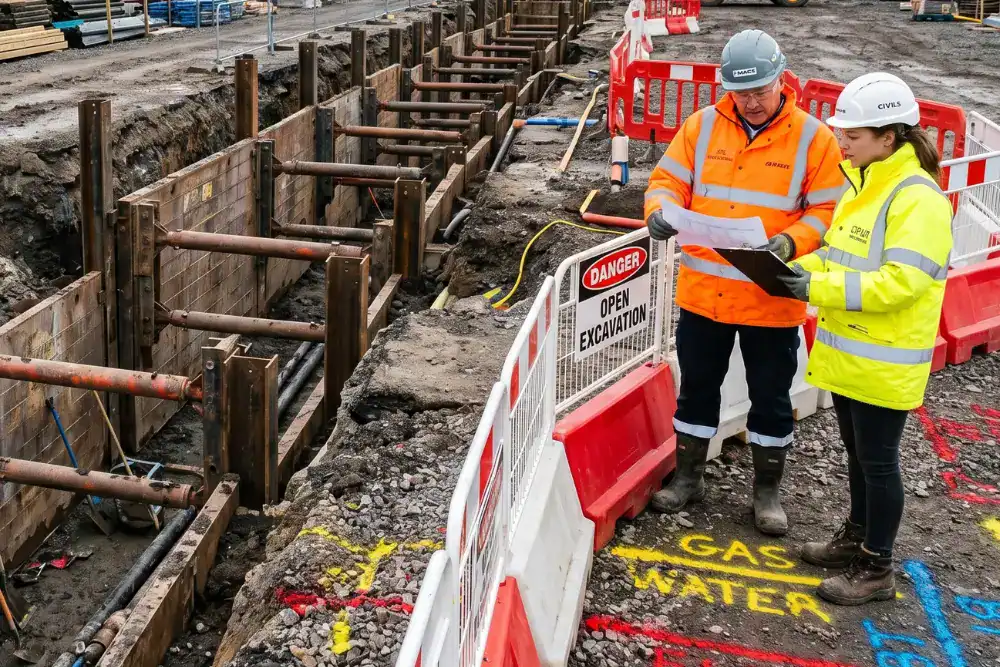
Regulation 22 requires that, where necessary to prevent danger to any person, the excavation is supported by suitable equipment so that no person is injured by the collapse of the excavation, the fall or dislodgement of any material or the burial or trapping of any person (UK Government, 2015a).

In practice, this means contractors carrying out excavation work must provide supports or sloped-side excavation (battering) where the ground will not safely stand alone, prevent material from falling into the excavation and prevent overloading of adjacent ground with plant or materials.

The Health and Safety Executive (HSE) is clear that no ground can be relied upon to stand unsupported in all circumstances, so a shallow depth alone is not a safe-by-default condition. It is an assumption that must be tested (HSE, n.d., a).

Foreseeable Excavation Hazards

HSE identifies the foreseeable hazards that excavation work creates as including collapse of the excavation, falling or dislodged material, people falling into the excavation, undermining of nearby structures, contact with underground or overhead services and the inflow of ground or surface water.

Contractors carrying out the excavation work, and, where appointed, the principal contractor coordinating the project, must address each of these hazards through proper planning, risk assessment and design of the temporary works (HSE, n.d., a).

Temporary Works as an Engineered Control

HSE’s temporary works guidance treats excavation support as an engineered solution that must be designed, installed, maintained and used as intended. The guidance describes the Temporary Works Coordinator (TWC) model as an effective way to manage this, including the authority to stop work where temporary works are not satisfactory (HSE, n.d., b).

HSE’s management guidance for temporary works in construction sets out a required procedure covering a design brief, design, design check, controlled installation and formal written permissions where needed, for example permits controlling when temporary structures can be loaded or taken apart (HSE, 2010).

Why Do Temporary Works Controls Commonly Break Down?

HSE has identified the recurring causes of temporary works failure as including the absence of a documented temporary works procedure, no appointed TWC, inadequate site investigation (including services and adjacent structures), unauthorised changes during construction, overloading of the temporary works and poor communication of design assumptions to the people doing the work (HSE, 2010).

In many organisations, temporary works are treated as equipment to install rather than as an engineered structure to manage. In these settings, design assumptions about soil type, loading, water levels and adjacent structures are not communicated to the site team, and decisions about installation, modification and use are made at the face of the excavation. When conditions change, the design is not re-checked.

When Must Excavations Be Inspected under CDM Regulation 22?

Where supports or sloped-side excavation (battering) is used to prevent collapse, CDM Regulation 22(4) requires a competent person to inspect the excavation at the start of each shift before work begins, after any event likely to have affected stability and after any fall or dislodgement of material. Work must not be carried out unless the competent person is satisfied that the excavation is safe (UK Government, 2015a).

This is not a procedural check. It is a designed brake on the work. Where the competent person is not satisfied, Regulation 22(5) prevents construction work from continuing in the excavation until the matter has been satisfactorily remedied (UK Government, 2015a).

Reporting Excavation Inspections

Regulation 24 then sets the reporting duties that follow. Before the end of the shift, the person carrying out the inspection must inform the relevant person if it has revealed a matter giving rise to a risk of injury.

Within 24 hours, the inspector must prepare a written report and provide it to the person on whose behalf the inspection was carried out. The report must be kept available on site until the construction work is completed and retained for three months thereafter (UK Government, 2015b).

Where start-of-shift inspections are carried out repeatedly within a 7-day period, only one written report is required to cover those inspections rather than a separate report for each shift.

Why Do Excavation Inspection Regimes Often Fail?

In many cases, inspections are carried out but do not control work. Either the competent person lacks practical authority to halt the excavation, or the organisation cannot resource remedial action quickly enough to remedy what has been found without losing programme. In many organisations, the system quietly conditions people to continue work despite unresolved findings.

HSE’s practical leaflet on excavation reinforces the same principle. The required actions are to support the excavation sides by shoring, stepping or battering, keep plant and materials away from the edge and check daily and after any event that may have affected stability (HSE, 2019a).

How Should Underground Services Be Managed during Excavation?

Underground services should be managed through a three-part safe system of work:

  1. Plan the work. Find out what services may be present in the area of the excavation. Gather available service plans, drawings and records, and use them to decide how the excavation will be carried out.
  2. Locate and identify services on site. Use cable and pipe locators and any other detection tools to confirm what is in the ground and where it runs. Mark the position of identified services on the surface before excavation begins
  3. Excavate safely. Use controlled excavation methods, particularly close to suspected services, so that even if the available information turns out to be wrong or incomplete, the risk to people and to the services themselves is managed (HSE, n.d., c).

Why Service Information Must Be Verified

One of the key reasons HSE structures underground service management this way is that information about buried services is often uncertain. Records may be inaccurate, detection technology has limits and no single source is reliable on its own.

The three-part safe system does not depend on any one input. It combines planning, on-site verification and conservative excavation methods so that no single source has to carry the full weight of accuracy.

HSE’s practical guidance on avoiding concealed services makes the same point in operational terms. Contractors must obtain plans before excavation begins, use locating devices on site, mark service routes and restrict mechanical excavation close to suspected services (HSE, 2019b). These are system-level controls embedded into the method of work, not reminders for individuals to exercise caution.

Why Records Alone Are Not Enough

Sector guidance reinforces why service records alone are not enough. The National Joint Utilities Group’s positioning and colour coding guidance warns that contractors and duty holders should not assume all mains and services conform to positioning recommendations. It also notes there are no statutory obligations governing the position or depth at which utility apparatus must be laid within the highway (NJUG, 2013).

The current Street Works UK guidance is explicit that it is not exhaustive, may not be applicable in all situations and is not warranted to be complete or accurate (Street Works UK, 2023). Service records should be treated as a starting point for risk control, not as proof of what is actually in the ground.

How PAS 128 Supports Better Procurement

PAS 128 (the publicly available specification that defines and categorises different types of utility survey by quality and accuracy) adds value at the procurement stage. It requires the client and project team to specify what level of survey is being commissioned (records search, walkover reconnaissance, detection or verification) and what quality and accuracy is required, so that the deliverable matches the actual risk on site.

The Chartered Institution of Civil Engineering Surveyors (CICES) client specification guide is explicit that clients need to specify the type of PAS 128 survey required and the level of detail expected, and includes advisory notes on the limitations of record-only information (CICES, 2022).

The Role and Limits of NUAR

The National Underground Asset Register (NUAR) improves access to consolidated underground asset data in England, Wales and Northern Ireland, but government guidance is clear that responsibility for deciding how and when that data is used within safe excavation processes remains with those carrying out excavations (GOV.UK, 2026).

Why Detection Still Does Not Remove Uncertainty

Detection on site is also not certainty. The Survey Association notes that no technology can guarantee accurate detection of all buried utilities, and that routes transcribed from utility records onto site drawings may have undefined accuracy (The Survey Association, 2025). Safe excavation systems must continue to control exposure to buried services even after good information has been obtained.

Why Does Underground Service Management Fail in Practice?

In many cases, service management fails when uncertainty is treated as certainty and changes to the excavation are treated as routine. Drawings, scans and digital data create confidence, but they do not remove inaccuracy. When unexpected services force a deeper, wider or locally undermined excavation, those changes often bypass temporary works review and inspection triggers, and the excavation continues as if nothing structural has changed.

What Are the Key Conclusions on Preventing Excavation Collapse?

Excavation collapse is most reliably prevented when temporary works, statutory inspections and underground service management operate as a single change-controlled system rather than three separate procedural exercises.

The regulatory framework under CDM 2015 in Great Britain reflects this. Regulation 22 requires both engineered precautions and inspection and prevents work continuing where the competent person is not satisfied, while Regulation 24 sets out the reporting duties that follow. HSE guidance on temporary works and underground services then requires that conditions are reduced and managed rather than assumed.

The Role of Training in the System

Training has a defined role in this framework. It supports contractors and site teams in understanding detection limits, the limitations of service records, controlled excavation methods and the conditions under which a service discovery or loading change should trigger a re-check rather than improvisation. Training is the means through which the people on site recognise when temporary works design, change control, supervision and stop authority need to be applied, but it does not replace those controls.

Three Questions before Work Begins

Before work begins on the next excavation, those responsible for the work should be able to confirm three things:

  1. The temporary works design assumptions and the change triggers that require a re-check before work continues.
  2. Who has the authority to stop the work, and how remedial action can be resourced within the same shift.
  3. The level of confidence in the available service information, and the conservative limits that apply on site when that information turns out to be wrong.

If these three questions cannot be answered clearly and with documented evidence, the system is not yet one that is likely to hold under pressure.

Supporting Competent Excavation Safety

Preventing collapse and protecting site teams during excavation work depends on principal contractors, site managers and supervisors who understand both the legal requirements and the operational decisions that turn those requirements into safe work.

Human Focus’s Excavation Safety Training covers CDM 2015 duties for excavation, temporary works requirements, statutory inspection triggers and the safe system of work for managing underground services. The course produces a verified record of completion to support your competence and audit trail. It is suitable for site managers, principal contractor staff, health and safety leads and excavation supervisors.

About the author(s)

Human Focus Editorial Staff comprises a dedicated collective of workplace safety specialists and content contributors. The team shares practical guidance on human factors, risk, and compliance to support safer, more effective workplaces.

Share with others
You might also like

Popular Courses

GDPR Awareness Training Course
GDPR Training
View Course Details
LOTOTO online training course
Safe Isolation – Lock Out, Tag Out, Try Out (LOTOTO) Training
View Course Details
IOSH Managing Safely
IOSH Approved Managing Safely e-Learning
View Course Details
spill kit training
Spill Kit Hazardous Substances Training
View Course Details
Legionella-Risk-Assessment-Training
Legionella Risk Management Principles for Responsible Persons
View Course Details

Recent Articles

bespoke safety training
Bespoke Safety Training for High-Hazard Work: Designing Competence Beyond Off-the-Shelf Courses
legionella monitoring records
Legionella Monitoring Records Gaps Across Multi-Site Estates: Why Compliance Keeps Slipping Through the Cracks
Most In-Demand Construction Safety Courses
Top 5 Most In-Demand Construction Safety Courses for UK Workplaces
security awareness training platform
Security Awareness Training Platform: How to Choose the Right Solution for Your Organisation
Course Announcement Manual Handling in Industry For Managers Training
Course Announcement: Manual Handling in Industry – For Managers Training

Current Offers

CAT & Genny Training

Original price was: £150.00.Current price is: £125.00. +VAT

near miss reporting for effective learning
Managing Near Miss Reporting for Effective Learning

Original price was: £895.00.Current price is: £595.00. +VAT

Sustainability and Environmental Management Training
Sustainability & Environmental Management Training

Original price was: £895.00.Current price is: £595.00. +VAT

lifting operation
LOLER Training

Original price was: £25.00.Current price is: £19.95. +VAT

colour blind test
Colour Blind Test

Original price was: £25.00.Current price is: £15.00. +VAT