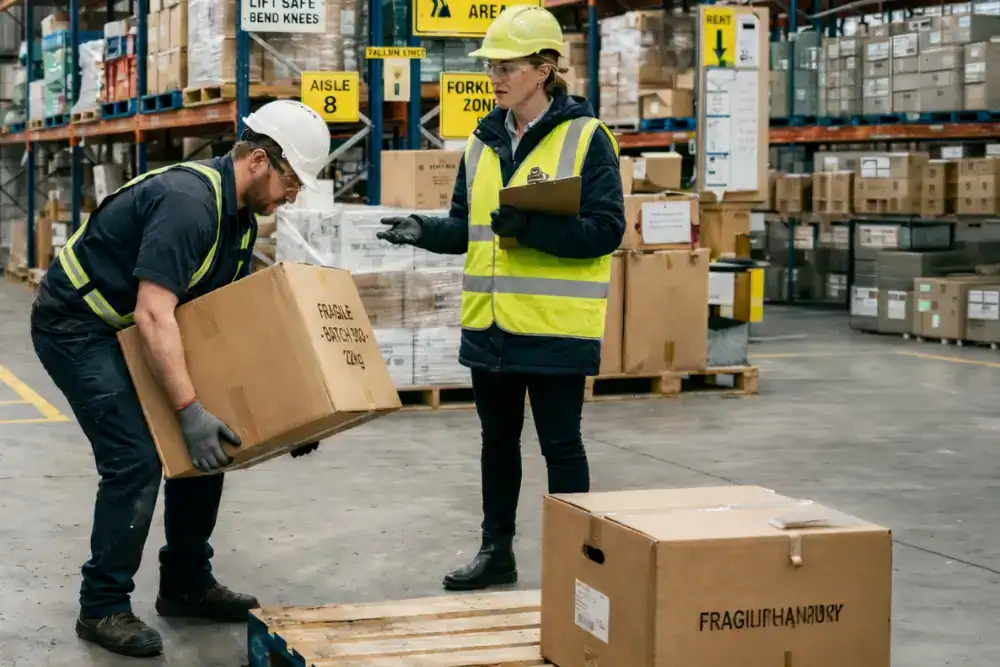
Manual handling injuries are common in industrial workplaces. Every lift, carry, push or pull brings a risk of back injury and other musculoskeletal problems. Training helps, but on its own it rarely changes behaviour for long.
This IIRSM-approved Manual Handling in Industry For Managers course helps managers deal with those risks in a practical, straightforward way. It shows them how to spot unsafe handling, give clear, constructive feedback and understand why poor handling practices persist.
This course is for managers and supervisors responsible for manual handling in industrial workplaces. It is relevant across warehousing, manufacturing, logistics, distribution and any setting where manual handling is a part of normal daily work.
It is suitable for:
Operations managers
Warehouse managers
Production managers
Shift supervisors
Team leaders
Logistics managers
Health and safety managers
Course Content
The Manual Handling in Industry – For Managers course contains the following sections:
Understand the scale of organisational risk from manual handling, including injury, financial and legal consequences. Recognise why safe technique training alone is not enough and why managers play a vital role in reinforcing safe behaviour.
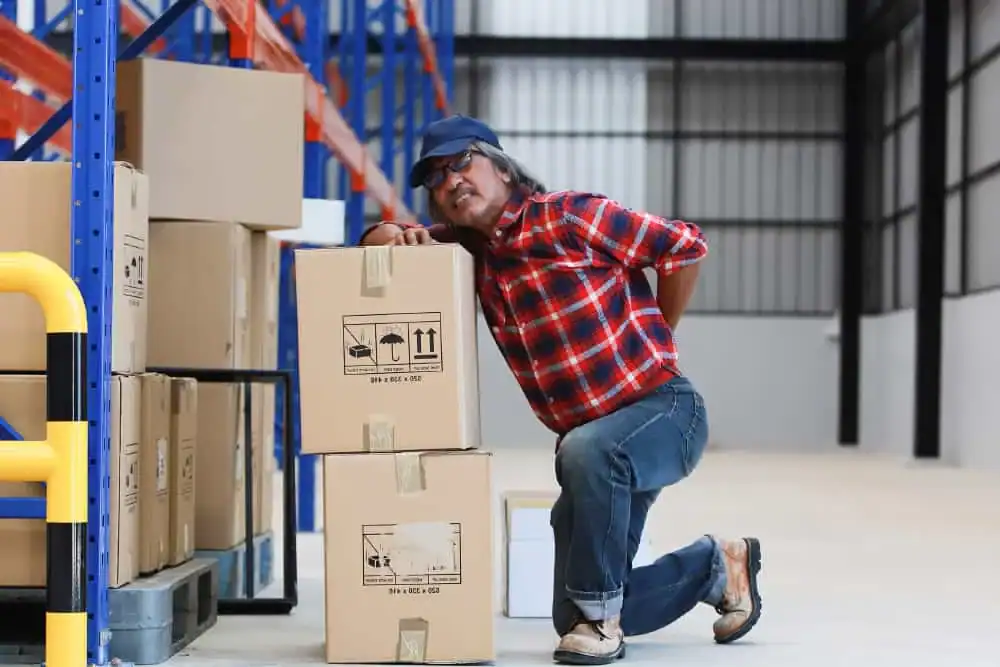
Recognise the stressful postures that cause back injuries and how load distance, bending and twisting increase spinal forces. See how slips, trips, hand injuries and musculoskeletal disorders arise during routine handling.
Know what PPE to wear before handling and why each item protects against specific injuries. Understand how to check the work area and the load for hazards before any lift begins.
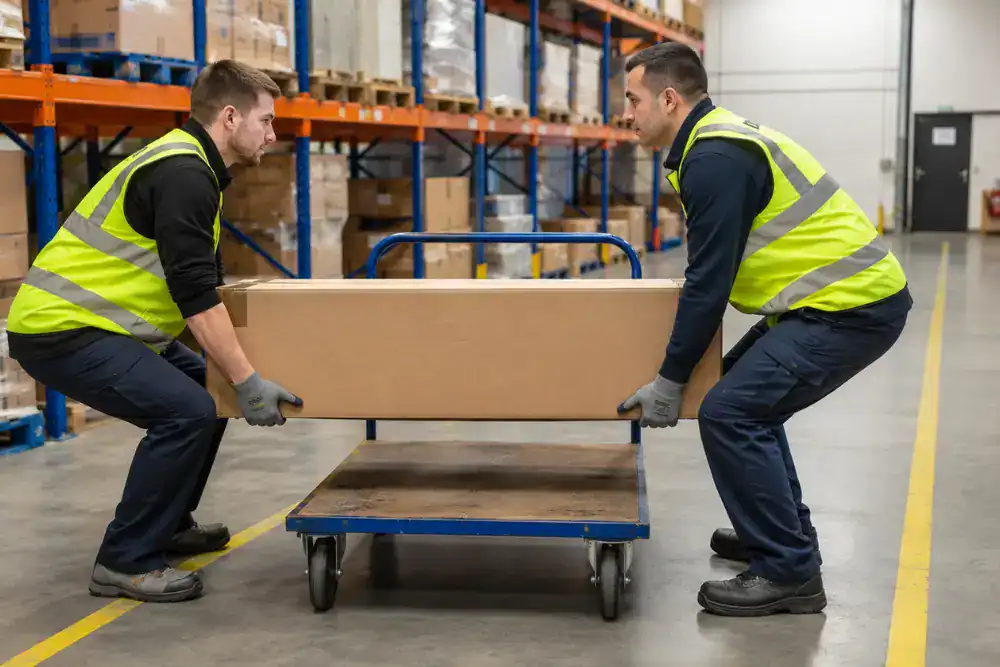
Understand how to position feet shoulder-width apart with one foot forward for stability in two directions. See how to reposition to a corner angle when the load restricts normal foot placement.
Understand why a bent back adds upper body weight to the spinal load and increases leverage. Recognise the correct technique: bend knees, keep head upright and maintain a straight back when lifting and lowering.
Understand how horizontal distance from the body multiplies the force on the back. Learn the correct technique for picking up, carrying and setting down loads as close to the body as possible.
Recognise that a load’s centre of gravity can sit away from the body even when the load appears close. Understand how to rotate loads and secure a good grip before taking any weight.
Understand why twisting at the waist with feet planted adds substantial forces to the lower back. Learn to move feet rather than twist, and to use pushing and pulling to avoid overstretching.
Recognise that heavy, bulky or unstable loads should be split and lifted individually to reduce strain on the back. Understand that load weight, size and stability all affect whether splitting is needed.
Understand that stacked loads must be balanced and secure to protect workers and prevent stock damage. Recognise that checking stacked loads takes only seconds and is a basic final check.
Training alone rarely produces lasting improvements in worker behaviour. Understand why workplace pressures cause workers to revert to old habits. Recognise that the manager’s active role in providing feedback is essential.
Constructive feedback changes behaviour without creating a policing culture. Learn a four-step method: give feedback immediately, be specific about the behaviour, acknowledge correct behaviour first and ask open questions.
Persistent unsafe behaviour often has a structural cause that feedback alone cannot fix. Learn to ask “why” and follow the causal chain to the root problem so it can be removed.
What Your Staff Will Learn
By completing this training, managers will be able to:
Recognise the postures and conditions that cause manual handling injuries, including how load distance affects back strain
Understand the eight principles of safe manual handling well enough to identify specific technique errors in others
Understand why training alone rarely sustains safe behaviour and what managers must do differently
Identify technique errors including bending at the waist, twisting and carrying loads away from the body
Apply a four-step feedback method to change manual handling behaviour constructively and without confrontation
Give feedback that builds safe habits rather than creating a policing culture
Investigate persistent unsafe behaviour by following the chain of causes back to the root problem
Remove workplace obstacles that prevent safe manual handling from being adopted in practice
Available in 20+ Languages
Course subtitles are available in multiple languages, including:
This course is approved by IIRSM – the International Institute of Risk & Safety Management.
The course certificate includes:
User name
Company name
Course name
Completion date
Expiry date
Approval body
An IIRSM-approved course certificate will be available for download and printing instantly upon course completion.
Users must complete a final theory test before earning their certificate.
The end-of-course test is:
Fully online
Multiple choice
A score of 80% is required to pass.
Course attempts
Each licence includes one attempt at the final knowledge assessment.
If a trainee does not pass and wishes to try again, an additional licence is required. For their second attempt, the trainee can retake the assessment without repeating the course content.
Customer Feedback
Why Manual Handling in Industry For Managers Training Is Important
Manual handling injuries are among the most common causes of workplace harm in industrial environments. Musculoskeletal disorders account for more than a quarter of work-related ill health in Great Britain. These injuries cause lasting physical harm to workers. They also drive significant costs through absenteeism, reduced productivity and staff turnover.
Lifting, carrying, pushing and pulling loads are routine operations in warehousing, manufacturing, logistics and distribution. Bending at the waist, twisting with feet planted and holding loads at arm’s length all increase force on the back. These stressful postures are common contributors to manual handling injuries. Managers who cannot recognise them leave unsafe techniques uncorrected.
The Manual Handling Operations Regulations 1992 have required employers to manage these risks since 1993. Employers must avoid hazardous manual handling where reasonably practicable. They must assess and reduce the risk where avoidance is not possible.
In practice, manual handling injuries persist despite training and legal duties. The most common failure points are:
Workers reverting to unsafe postures after training when safe practice is not reinforced day to day
Managers observing unsafe behaviour but not responding to it
Feedback that blames the person rather than correcting the specific behaviour
Persistent problems going uninvestigated while the same feedback is repeated against structural obstacles
This course gives managers practical ways to deal with those problems. It helps them spot unsafe handling, respond constructively and investigate why the same issues keep happening. This makes it more likely that training will lead to safer handling in everyday work.
How This Training Helps Your Organisation
Beyond individual manager competence, this training supports wider organisational control of manual handling risk by:
Reducing the frequency of manual handling injuries and musculoskeletal disorders through manager-reinforced safe working practices
Ensuring managers respond consistently and constructively to unsafe manual handling behaviour rather than overlooking it
Improving consistency in manual handling safety standards across teams and shifts
Supporting compliance with legal obligations for manual handling risk assessment and control
Reducing the financial and operational impact of absenteeism and staff turnover caused by manual handling injuries
Start Your Manual Handling in Industry – For Managers Training Today
Give your managers the skills to recognise unsafe behaviour and respond constructively. Help them investigate the root causes that training alone cannot fix. Enrol your management team today and build the consistent safety standards your organisation needs.