In-Service Inspection & Testing of Electrical Equipment (ISITEE)
schedule
Course Duration: 50+ minutes
This RoSPA-assured Portable Appliance Testing (PAT Testing) Course explains how to visually inspect and test portable appliances using a PAT device.
It includes video demonstrations for testing extension leads, Class 1, and Class 2 appliances, with guidance on interpreting and recording results. The course also provides an overview of PAT standards and requirements, including the equipment needed, test types, labelling, and when to test different appliances. Course users gain access to a PAT e-Checklist to guide and document tests. Results are stored digitally for straightforward record-keeping and evidence of outcomes.
Get discounts when you order in bulk. Enrol your team at a lower cost per trainee. Deliver and track training online with an all-in-one safety competency solution.
Discount Details
Course Preview
Course Details
Course Duration
50+ minutes
Approval body
RoSPA
Format
Fully online
Assessment
Multiple choice
Certification
Same-day digital certificate
Certificate Valid For
3 years
Suitable For
Facilities managers
Health and safety officers
Electrical technicians
Maintenance teams
Office administrators
Small business owners
Course Content
This course contains the following sections:
Explores why we need portable appliance testing, the risk of injuries related to electrical accidents and how they can occur.
Examines the legal duties and relevant code of practice for workplace electrical safety, and how PAT can help meet these requirements.
Explains the various types and classes of portable appliance and their key differences.
Provides a thorough understanding of the visual and electrical tests that make up PAT, including equipment, frequency, and appliances to be checked, plus requirements for individuals carrying out portable appliance testing.
Explains the importance of formal visual inspections and how to perform them.
Illustrates different types of tests and explains what each one does.
Describes how to perform extension lead tests, what equipment is needed and general precautions.
Demonstrates the Class 1 appliance test, including the process of visual inspection, the necessary equipment and recording results.
Demonstrates the Class 2 appliance test, including the process of visual inspection, the necessary equipment and recording results.
What You Will Learn
Requirements of portable appliance testing
Types & classes of portable appliances
Visual inspection process
How to conduct tests and interpret the results
Pass & fail criteria during inspections and testing
Available in 20+ Languages
Course subtitles are available in multiple languages, including:
This course is assured by the Royal Society for the Prevention of Accidents (RoSPA).
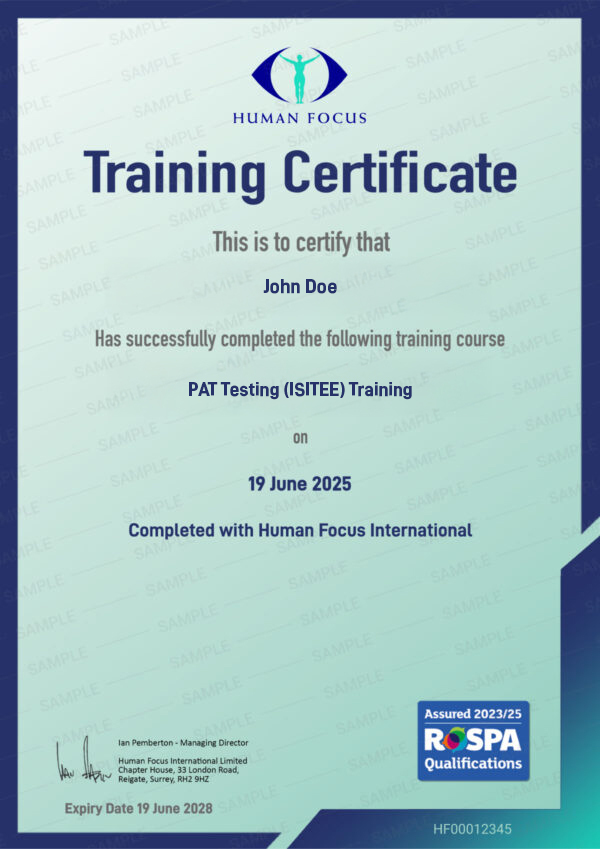
The course certificate includes:
User name
Company name
Course name
Completion date
Expiry date
Approval body
A RoSPA-assured PAT Testing Course certificate will be available for download and printing instantly upon course completion.
Users must complete an assessment before earning their certificate.
The end-of-course test is:
Fully online
Multiple choice
A score of 80% is required to pass.
Free Portable Appliance Testing e-Checklist
This online training course comes with a free e-Checklist to support your inspections and portable appliance tests.
Structure your portable appliance tests – Follow each step in the correct order to ensure thorough and consistent appliance checks.
Reduce admin time – Record results digitally as you work, eliminating manual paperwork and saving time on documentation.
Prove outcomes – Store clear, trackable evidence of completed tests for internal records or client reporting.
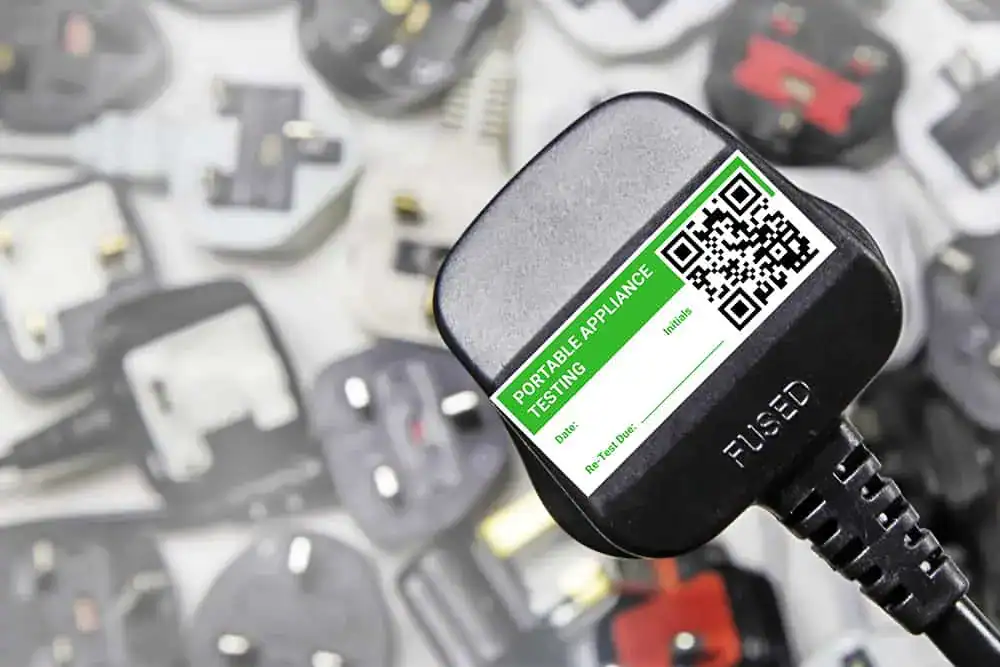
Manage appliances – Use QR codes to access completed forms instantly and share them securely when needed.
Note – This offer is for one PAT e-Checklist licence per trainee who completes this course. This e-Checklist licence is for their use and cannot be transferred or shared by other users.
Terms and conditions apply – access to this e-Checklist is for 12 months from purchase.
Customer Feedback
Why Is this PAT Testing Course Important?
Faults in electrical appliances can cause electric shocks and burns, which can result in severe or fatal injuries to those involved, as well as fire. According to the Health and Safety Executive (HSE), portable appliances accounted for over 25% of all electrical accidents, while of some 30,000 fires seen in England, nearly 45% were caused by electrical faults.
Due to the risk involved, there is a clear legal requirement to control the hazards of electrical appliances and equipment.
Under the Health and Safety etc. Work 1974, employers must provide a safe working environment, free from hazards such as those of portable electrical equipment. The Electricity at Work Regulations 1989 and Provision and Use of Work Equipment Regulations, or PUWER, 1998 further underscore these duties, which require that electrical equipment must be in a suitably safe condition and subject to regular inspections, as required.
About This PAT Testing Course
This online Portable Appliance Testing (PAT) training course provides the knowledge needed to carry out visual inspections and tests of portable appliances using a PAT device.
It includes an overview of test procedures, results and record-keeping, as well as relevant regulations and standards. Trainees who complete the course and have sufficient experience will understand how to conduct safe, effective portable appliance testing.
How This Training Helps Your Organisation
This course helps organisations:
Build in-house competence to inspect and test portable appliances safely
Support compliance with the Electricity at Work Regulations 1989, PUWER 1998 and the Health and Safety at Work etc. Act 1974
Improve consistency of visual inspections, testing and result recording across sites and teams
Maintain clear, audit-ready evidence of completed inspections and test outcomes
Reduce the risk of electric shocks, burns and fires caused by faulty portable appliances
By improving staff understanding of how to inspect, test and document portable appliances correctly, this training supports more reliable electrical safety controls across the workplace.
Frequently Asked Questions
Portable appliance testing (PAT or sometimes PAT testing) is the leading method of checking that electrical devices are safe. PAT confirm that devices are working normally and do not pose an electrical or fire risk.
The full procedure includes a visual inspection for any damage or faults as well as testing of the circuitry and insulation using a portable appliance tester.
Depending on the results, appliances are marked as either “safe to use” or “unsafe”. Unsafe appliances cannot be used until they have been repaired by a suitably qualified person and re-tested.
Yes. Portable Appliance Testing (or PAT testing) is now increasingly referred to as Electrical Equipment Testing (or EET testing). The test itself is unchanged — it is still the same process of visual inspection, electrical testing and labelling.
The change was prompted by the Institution of Engineering and Technology (IET) in its 2020 Code of Practice for In-Service Inspection and Testing of Electrical Equipment (ISITEE). The IET considered “portable appliance testing” misleading, as it suggested only small, movable household-type items needed testing. In practice, fixed equipment such as fridges, desktop computers, power tools and extension leads also require regular checks.
The new name reinforces that all mains-powered electrical equipment in the workplace should be inspected and tested, not just portable items.
No. PAT is not specifically named in any legislation. However, the Electricity at Work Regulations 1989 require employers to maintain electrical equipment in a safe condition. PAT is one of the most effective ways to confirm that this duty has been met. Several industry bodies, plus the Health and Safety Executive (HSE), strongly recommend that workplace equipment undergo regular portable appliance testing to verify its safety.
No. You do not need to be a qualified electrician to carry out PAT testing (now also known as Electrical Equipment Testing), and UK law does not require a specific qualification.
The Electricity at Work Regulations 1989 require that inspection and testing be carried out by a competent person — defined by the Health and Safety Executive (HSE) as someone with the right combination of training, knowledge, skills and experience to perform the task safely and avoid electrical danger.
This course provides a detailed understanding of portable appliance testing, including pass/fail criteria and step-by-step testing procedures suitable for a wide range of work environments.
However, electrical risks can vary significantly between settings. Before carrying out any inspections or tests, you must ensure you are competent to do so safely and that your knowledge is appropriate for the specific environment. This is a legal requirement under health and safety law.
This course is assured by the Royal Society for the Prevention of Accidents (RoSPA). Assurance proves the course meets the high standards for quality and accuracy set by RoSPA.
Yes. After successfully completing the course assessment, you’ll earn a RoSPA-assured training certificate. It will be available to download instantly upon course completion.
The training certificate is valid for three years. After this period, you’ll need to repeat the course to refresh your knowledge and renew your certification.
The course is £49 + VAT for a single trainee. Discounts are available on volume purchases. Speak to one of our sales team to learn more, or click on ‘Discount’ beneath the ‘Buy Now’ button at the top of the page for more details.
This online PAT testing course takes approximately one hour to complete in one sitting. You can pause and resume training when you’d like.
It covers the PAT process and other relevant topics related to workplace electrical safety, including:
Relevant guidance and legislation
Electrical safety principles
PAT testing equipment
Testing procedures
PAT record keeping and reporting
The course explains each step of the PAT test process, complete with video demonstrations. However, it won’t necessarily prepare you for carrying out full PAT tests on all types of electrical appliances.
PAT tests can only be conducted by competent individuals. This requirement means you will need the right combination of training, skills, experience and knowledge to conduct PAT tests safely and legally.
Completing the course will help you towards this level, but you also need sufficient hands-on experience.