Modern Slavery Awareness Training

Modern Slavery Training

schedule

Course Duration: 35+ minutes

This CPD-certified Modern Slavery Training course helps your organisation meet its duty to identify modern slavery and protect those affected by this serious crime.

The course provides essential awareness of the main types of modern slavery present in today’s workplaces and supply chains and presents case studies to show where and how they occur in the UK. By the end of this course, users will be equipped to notice signs of modern slavery and take appropriate next steps to help protect victims and their organisation.

live_tv
100% online training
volume_up
Full audio voiceover
repeat_on
Fully online assessment
account_balance_wallet
Discounts when you buy in bulk
important_devices
Access on any device
app_shortcut
App available for iOS & Android
Training You Can Trust

Certified by CPD

In line with UK legislation

Certificate on completion

Developed by health and safety professionals

Modern Slavery Awareness Training Certification
Modern Slavery Awareness Training
cpd certified
£25.00 +VAT

Discounts  for bulk purchases

Need Help?

£25.00 +VAT

Course Preview

Course Details

Course Duration 35+ minutes
Approval body CPD
Format Fully online
Assessment Multiple choice
Certification Same-day digital certificate
Certificate Valid For 3 years

Suitable For

Frontline Workers

HR Professionals

Social Workers

Healthcare Staff

Supply Chain Managers

Compliance and Legal Advisors

Course Content

This course contains the following sections:

Explains what modern slavery is and the scope of the problem in the UK.

Provides an overview of UK laws on modern slavery.

Discusses how perpetrators exploit vulnerabilities to entrap victims.

Explains what human trafficking and forced criminality mean and how they occur.

Explains what labour exploitation looks like and where it can occur.

Explains what domestic servitude involves and how it occurs.

Explains what sexual exploitation involves and how it occurs.

Describes common indicators and warning signs that show someone may be a victim of modern slavery.

Explains what to do if you suspect modern slavery and who to reach out to.

What You Will Learn

What modern slavery means and what it looks like

What the law says about modern slavery

How perpetrators exploit and entrap people with vulnerabilities

What are the most common forms of modern slavery

What warning signs show that someone may be a victim

How to report concerns and who to report them to

Available in 20+ Languages

Course subtitles are available in multiple languages, including:

French

Dutch

German

Italian

Spanish

Polish

Course Approval Body

cpd certified

Certified by CPD

This course is certified by the Continuing Professional Development (CPD) Certification Service.

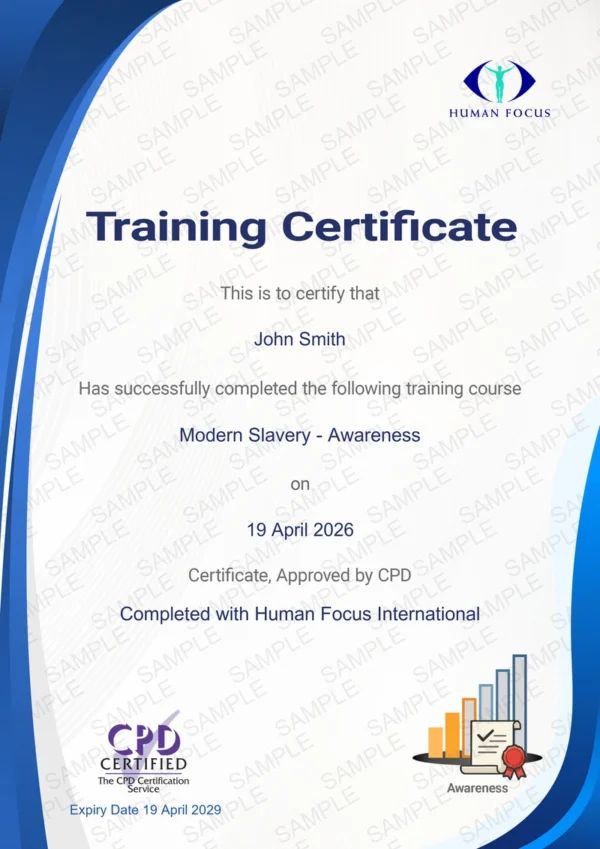
The course certificate includes:

  • User name
  • Company name
  • Course name
  • Completion date
  • Expiry date
  • Approval body

A CPD-certified modern slavery awareness training certificate will be available for download and printing instantly upon course completion.

Users must complete an assessment before earning their certificate.

The end-of-course test is:

  • Fully online
  • Multiple choice

A score of 80% is required to pass.

Modern Slavery Awareness Training Certification

Customer Feedback

Why Modern Slavery Training is Important

There is no one face to modern slavery. Victims can be colleagues, contractors brought in for temporary work, or people in the local community.

Victims are often hard to recognise. Those around them may not realise what is happening, and victims themselves may not know how to ask for help or may feel unable to. Some appear to have a degree of freedom, yet are controlled through fear, debt and threats.

Employers and organisations have a responsibility to manage modern slavery risks in their operations and supply chains. To meet these duties, staff need clear knowledge of what modern slavery is and how it appears in real situations. Training helps people challenge false assumptions, notice warning signs and act when something looks wrong.

The Scale of Modern Slavery in the UK

Modern slavery is far more common than most workplaces assume, and the numbers are rising.

  • The House of Lords Modern Slavery Act 2015 Committee has cited an estimate of around 130,000 victims of modern slavery in the UK.
  • In 2025, 23,411 potential victims were referred to the National Referral Mechanism — the highest annual total since the system began and a 22% rise on the previous year.
  • Referrals have climbed sharply over the past decade, yet the people identified are only a fraction of the true total.
  • Labour exploitation is the most commonly reported type, with construction, agriculture, hospitality and care among the sectors most affected.
  • Of those referred in 2025, 70% were adults and 30% were children; children were most often exploited for criminal activity such as drug trafficking.
  • Cases are recorded in every region of the UK, from major cities to rural areas.

These figures show modern slavery is not a remote or overseas problem. It occurs in ordinary UK workplaces and supply chains, which is why frontline staff are often best placed to spot it.

Are You Aware of Your Responsibilities?

The Modern Slavery Act 2015 places two kinds of duty on organisations. Committing slavery, forced labour or human trafficking is a criminal offence. Separately, larger organisations must report publicly on the steps they take to keep it out of their business and supply chains.

That reporting duty sits in Section 54 of the Act. It applies to commercial organisations that carry on business in the UK and supply goods or services. It takes effect at a total annual turnover of £36 million or more, including subsidiaries, and requires an annual modern slavery statement.

Government guidance recommends that the statement covers:

  • The organisation’s structure and supply chains
  • Its policies on slavery and human trafficking
  • The due diligence checks it carries out
  • How it assesses and manages risk
  • How it measures whether its actions are working
  • The training it provides to staff

The government has announced reforms that would strengthen these requirements, including proposals to make these areas mandatory. The changes are not yet in force, so organisations should continue to report under the current rules — but the framework is expected to tighten.

Smaller organisations are not exempt from the risk. The criminal offences apply whatever the turnover, and businesses below the threshold are increasingly asked by larger customers to show they manage modern slavery risk. In every case, staff who can recognise the warning signs are central to meeting these duties.

About This Training

Modern slavery in workplaces and supply chains often goes unnoticed because victims are disguised as legitimate workers. They can be found in almost every sector and every area of the country.

This online Modern Slavery Training course provides employees with a clearer understanding of modern slavery and human trafficking risk in the UK. They will know what modern slavery looks like, how to spot it and what action to take if they do.

How This Training Benefits Your Business

Beyond protecting potential victims, the training helps your organisation meet its responsibilities and reduce risk. It helps your business:

  • Demonstrate due diligence under the Modern Slavery Act 2015
  • Strengthen the credibility of an annual modern slavery statement where Section 54 applies
  • Give staff a consistent understanding of the warning signs and how to report them
  • Apply your modern slavery policy more consistently through better staff awareness and reporting
  • Reduce the risk of slavery or trafficking going unnoticed in your workforce or supply chain
  • Support ethical recruitment and procurement practices
  • Protect your organisation’s reputation by acting before concerns escalate

Aims of This Training

This training course aims to build awareness of modern slavery and equip staff to act on it. It aims to:

  • Help learners understand what modern slavery is and the different forms it takes
  • Show where and how it occurs in UK workplaces and supply chains
  • Build the confidence to recognise warning signs and challenge false assumptions
  • Make staff aware of their responsibilities and the relevant law
  • Ensure learners know how to report concerns and who to contact

Frequently Asked Questions

There is no blanket legal requirement to train every member of staff in modern slavery. However, under Section 54 of the Modern Slavery Act 2015, larger organisations are expected to report on the training they provide as part of their annual modern slavery statement. Training also helps any organisation demonstrate due diligence and support ethical recruitment and procurement.

This online training helps employers and staff understand the Modern Slavery Act 2015, including their responsibilities around risk awareness, reporting and due diligence.

Common types of modern slavery include:

  • Human trafficking – Moving or controlling people to exploit them
  • Forced labour – Making people work under threat, pressure or deception
  • Sexual exploitation – Coercing people into sex work or pornography
  • Domestic servitude – Exploiting people in private homes with little freedom
  • Criminal exploitation – Forcing individuals to carry out illegal acts, such as theft, fraud or drug trafficking

Modern slavery is often hidden, but there are common warning signs that someone may be a victim. These can include:

  • Appearing withdrawn, frightened or reluctant to speak to others
  • Having little control over their own identity documents, bank account or wages
  • Working long or unusual hours and rarely being allowed to leave the workplace
  • Living in overcrowded, poor or unsuitable accommodation, often arranged by an employer
  • Wearing the same clothes repeatedly or showing signs of neglect or untreated injuries
  • Being dropped off and collected from work at unusual times, often by the same person
  • Being unable to speak freely because someone else answers questions on their behalf

No single sign confirms modern slavery. The training helps staff recognise these indicators in context and know what action to take.

Slavery typically refers to the historical practice of owning people as property. Modern slavery refers to exploitative practices where people are controlled through coercion, deception or threats. Victims may appear free, but they’re often trapped in cycles of abuse, debt or fear, with no real means of escape.

This course provides practical modern slavery awareness training for employees whose role may bring them into contact with potential victims, or who have responsibilities in compliance, procurement or safeguarding.

Some roles that may benefit from this course include:

  • Frontline workers
  • HR professionals
  • Social workers
  • Healthcare staff
  • Supply chain managers
  • Compliance and legal advisors

Yes. Staff can complete this modern slavery course online on any device, making it easy to fit the training around work schedules

The course is priced at £25 + VAT for a single trainee. Discounted rates are available for bulk purchases. Click on ‘Discount’ below the ‘Buy Now’ button for more details.

Yes. This course is certified by the Continuing Professional Development (CPD) Certification Service.

Related Courses