Level 3 Food Safety Management and HACCP for Supervisors
schedule
Course Duration: Approximately 4 hours
Food safety problems rarely occur in isolation. Delayed checks, recurring non-conformances and missed critical limits usually trace back to something wider: the competence and capability of the people involved, the strength of the food safety culture around them, and how seriously the business commits to acting on what it finds and improving. Supervisors and managers sit at the point where all of that either holds together or comes apart.
This IIRSM-approved course gives them the technical grounding to do that job properly. Ten modules combine supervisory food safety management with four dedicated HACCP modules, a combination very few courses offer in a single programme. It covers how prerequisite programmes, operational prerequisite programmes (OPRPs) and HACCP work together, how to recognise when control is being lost, and what to do about it, including decisions on affected product.
At £95 + VAT this is a full ten-module supervisory programme rather than a short awareness course. It uses realistic chilled ready-to-eat manufacturing case studies throughout and concludes with a case-study-based final assessment. Successful learners receive a three-year certificate, with training records retained as evidence for due diligence, third-party audits and local authority inspections.
live_tv
100% online training
volume_up
Full audio voiceover
repeat_on
Fully online assessment
account_balance_wallet
Discounts when you buy in bulk
important_devices
Access on any device
app_shortcut
App available for iOS & Android
Training You Can Trust
Approved by IIRSM
Aligned with UK Legislation
Certificate on completion
Developed by health and safety professionals
Disclaimer: This course builds awareness and knowledge of food safety management and HACCP for supervisors. Completing it does not by itself make a learner competent or qualified for any task or role — under UK law, competence combines training, knowledge, skills and experience, and confirming it is the employer’s responsibility. It provides underpinning knowledge only; competence to develop, implement, or oversee a food safety management system also requires supervised practical experience and employer authorisation.
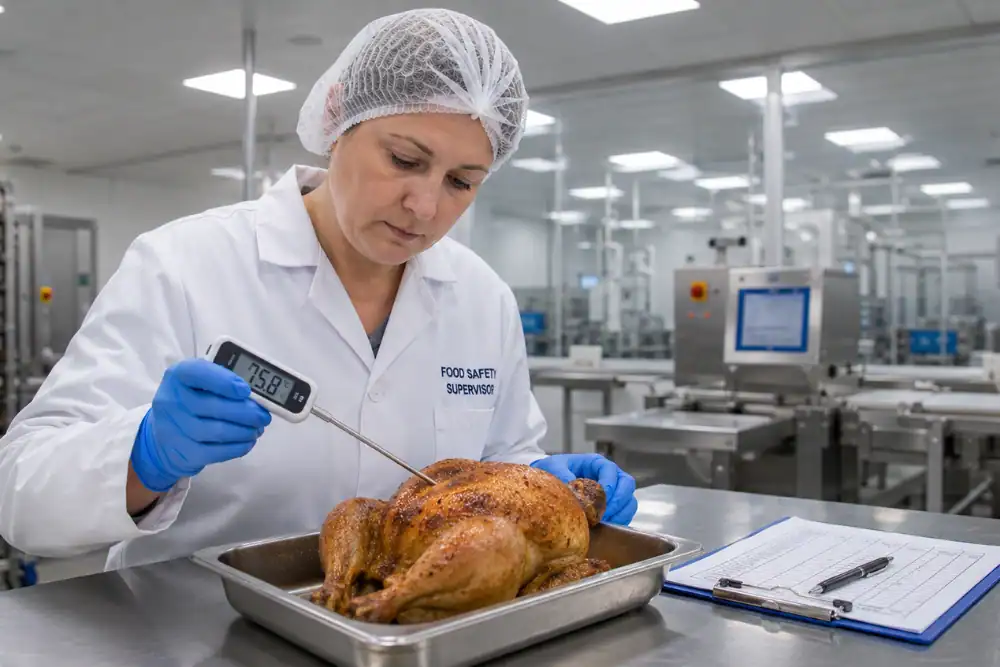
The Level 3 Food Safety Management and HACCP for Supervisors course is designed for supervisors and team leaders in food production, particularly chilled and ready-to-eat manufacturing where HACCP controls must be followed on every shift. It also suits supervisors in catering and retail food service moving toward a full HACCP-based system.
Food Production and Manufacturing Supervisors
Shift Supervisors and Production Line Leaders
Food Safety and Hygiene Supervisors
Cleaning and Hygiene Team Leaders
Quality Assurance and Technical Supervisors
Course Content
The Level 3 Food Safety Management and HACCP for Supervisors course includes the following modules:
Understand why food safety matters, the health, legal, operational and commercial consequences of failure and the legal and enforcement framework supervisors work within.
Why Food Safety Matters
The Legal Background
Enforcement Bodies & Food Safety Resources
Understand how a food safety management system identifies hazards, applies controls and records evidence that food safety is being managed, and where HACCP fits within it.
Food Safety Management Systems
Your Role in FSMS
Employee Role in FSMS
Recognise key microbiological, allergen and physical hazards, how they enter and spread through production and how changing, PPE, cleaning and waste practices can introduce contamination.
Microbiology
Food Allergens
Glass, Sharp Objects, & Restricted Items
Changing Clothes & PPE
Cleaning & Waste Procedures
Apply and supervise the personal hygiene, handwashing, wound-covering, appearance, conduct, changing and PPE procedures required in low-risk and high-risk food production areas.
Personal Hygiene & Cleanliness
Personal Appearance & Conduct
Changing Clothes & PPE
Apply and supervise day-to-day prerequisite controls across production, including temperature, stock rotation, cleaning and disinfection, allergen cleaning, COSHH, pest management, waste control and prompt action when standards are missed.
Temperature Control in the Food Chain
Stock Storage & Rotation Systems
Cleaning, Disinfection & Sanitising
Allergen Management Through Effective Cleaning
Safe Use of Chemicals
Pest Management & Waste Control
Assess how building fabric, lighting, ventilation, hygiene facilities, layout and equipment design prevent contamination, and how maintenance, calibration and records keep premises hygienic and reliable.
Fabric of the Building
Lighting & Ventilation
Layout & Workflow
Separation of Raw & Ready-to-Eat Areas
Handwashing Facilities
Equipment Standards
Staff Welfare & Changing Facilities
Maintenance & Records
Understand the 12-step Codex HACCP process and seven principles, how prerequisite programmes, operational prerequisite programmes and critical control points differ and the responsibilities of supervisors, the HACCP team and management in maintaining an effective system.
History & Development of HACCP Systems
12 Steps of HACCP
Principle 1: Conduct Hazard Analysis
Principle 2: Determine Critical Control Points or CCPs
Understand how food hazard analysis begins, from checking prerequisite programmes and management support to defining the scope, assembling the food safety team, describing the product and its intended use, constructing and verifying the process flow and identifying hazards at each step.
Initial Steps to Food Hazard Analysis
Process Flow Diagram Development
Methods of Hazard Identification at Each Step
Understand how identified hazards are assessed using likelihood-and-severity risk matrices and controlled using the hierarchy of controls, including the distinction between prerequisite programmes, operational prerequisite programmes and critical control points. See how these decisions are applied through a realistic UK chilled-food manufacturing case study.
Risk Assessment
Food Risk Control Measures
oPRPs
Case Study Part 1
Case Study Part 2
Bring the food safety management system together through a realistic case study of a high-volume chilled ready-to-eat operation. See how the system performs in normal conditions and under pressure, including HACCP and prerequisite programme integration, supervisory control, emerging control failures, complaint handling, withdrawal or recall decisions, continuous improvement and audit preparation.
How the FSMS Operated in Normal Conditions
Integrating HACCP with PRPs
Supervisory Control
The Complaint
Withdrawal Recall Decision
Continuous Improvement & Culture Actions
Audit Preparation
Disclaimer: This course provides knowledge and supporting guidance on food safety management and HACCP for supervisors. Completing it does not by itself make a learner competent or qualified for any task or role — under UK law, competence combines training, knowledge, skills and experience, and confirming it is the employer’s responsibility. It provides underpinning knowledge only; competence to develop, implement, or oversee a food safety management system also requires supervised practical experience and employer authorisation.
What You Will Learn
By the end of this course, you will be able to:
Recognise the biological, chemical, physical and allergen hazards that make food unsafe, and how they reach food during routine work
Understand your legal duties as a supervisor under UK food law, and how training, supervision and records support the due diligence defence
Monitor critical control points and act quickly when a critical limit is not met
Understand how food safety controls are selected and classified, using the same hierarchy of controls and CCP/oPRP decision tree used to build the HACCP plan
Apply the temperature, stock rotation, allergen, pest and chemical safety controls your team must follow every shift
Check that personal hygiene, PPE and changing procedures are being followed correctly and step in when they are not
Spot premises, equipment and maintenance issues that put food safety at risk, and know how to escalate them
Understand how a food safety complaint is investigated, and what your role is if it escalates to a product withdrawal or recall
Keep food safety working under pressure during busy periods, staff shortages and equipment faults
Understand what Environmental Health Officers and auditors look for, and how to keep your area inspection-ready
Available in 20+ Languages
Course subtitles are available in multiple languages, including:
This course is approved by IIRSM – the International Institute of Risk & Safety Management.
The course certificate includes:
User name
Company name
Course name
Completion date
Expiry date
Approval body
An IIRSM-approved course certificate will be available for download and printing instantly upon course completion.
Users must complete a final theory test before earning their certificate.
The end-of-course test is:
Fully online
Multiple choice
A score of 80% is required to pass.
Course attempts
Each licence includes one attempt at the final knowledge assessment.
If a trainee does not pass and wishes to try again, an additional licence is required. For their second attempt, the trainee can retake the assessment without repeating the course content.
Erica is an internationally recognised food safety expert with over 30 years’ experience across industry, academia and government. From 2019 to 2025 she was Director of the Global Food Safety Initiative (GFSI), the world’s largest collaboration for food safety.
At GFSI, which benchmarks the certification standards used across global food supply chains, she chaired a forum of more than 200 national food safety regulators and worked with WHO, FAO and Codex. Earlier, she authored the World Bank’s Food Safety Investment Climate Toolkit, led the rewrite of the food and water sections of the WHO Guide to Hygiene and Sanitation in Aviation, and led international regulatory missions as Assistant Director at the UK’s Office for Product Safety and Standards.
She began her career with 14 years as Technical Director of a UK ready-to-eat food manufacturer, then led MSc Food Safety programmes at the University of Lancashire and the University of Greenwich. She is the author of Aviation Food Safety and has supported Human Focus in developing its food safety courses.
Customer Feedback
Why Is Level 3 Food Safety Management and HACCP for Supervisors Training Important?
A documented food safety management system can still lose effectiveness when checks vary between shifts, warning signs are not escalated or production continues after a temperature, allergen or hygiene control has been missed.
Supervisors must recognise when monitoring shows a loss of control, hold affected food, escalate concerns and complete and record corrective action. These decisions are hardest during busy periods, staff shortages and equipment faults.
During food hygiene inspections, Environmental Health Officers assess how well training, supervision and records are being maintained. Gaps in training and control records can weaken the due diligence position, contribute to enforcement action and reduce the confidence-in-management element of a Food Hygiene Rating Scheme score.
These decisions require more than general food hygiene knowledge. Four dedicated HACCP modules cover the seven principles, hazard analysis, control classification and day-to-day food safety management alongside the routine controls supervisors oversee.
Realistic chilled ready-to-eat manufacturing case studies show how incomplete monitoring, unresolved faults and production pressure can develop into a food safety incident, and how supervisors should respond through product control, escalation, corrective action and accurate records.
How Level 3 Food Safety Management and HACCP for Supervisors Training Helps Your Organisation
Establish one supervisory standard for monitoring, escalation and corrective action across shifts, production lines and sites
Improve the response to missed limits, incomplete checks and recurring faults before they develop into wider food safety incidents
Reduce duplicated training and administration by combining Level 3 food safety management and practical HACCP learning in one course
Provide documented supervisor-level training that strengthens your evidence for due diligence, inspections and Food Hygiene Rating Scheme assessments
Improve readiness for regulatory inspections, customer audits and third-party certification assessments
Reinforce HACCP-based controls relevant to standards such as the BRCGS Global Standard Food Safety and IFS Food
Reduce the risk of product holds, recalls, production disruption and loss of customer confidence
Course Features
Self-paced, fully voiced learning that supervisors can complete across sessions around shift and production demands, without requiring a full day away from the operation
Compatible with desktop, tablet and mobile devices
Course manual to support learning
Module tests throughout
Case-study-based final assessment
Downloadable certificate on completion
Training records stored automatically for audit and inspection
Suitable for training supervisors across multiple sites and shifts
Certification
Learners who pass receive a Level 3 food safety training certificate valid for three years and recognised by Environmental Health Officers as evidence of appropriate supervisory training. Completion is recorded automatically for due diligence, audits and inspections.
Strengthen Food Safety Control on the Floor, Across Every Shift
Give supervisors one approach to routine food safety controls and HACCP deviations. Standardise product holds, escalation and recorded corrective action across shifts, lines and sites.