This IIRSM-approved ISO 9001 Implementation Training course outlines steps to achieving and maintaining ISO 9001 certification.
This multi-module course provides a foundational overview of the ISO 9001 quality management standard. It covers the standard’s scope, structure and certification requirements Users will understand how to establish a quality management system (QMS) that meets criteria for ISO 9001 certification and drives business performance.
The course comes with a free ISO 9001 GAP analysis digital checklist that helps users compare existing processes to the standard’s requirements.
live_tv
100% online training
volume_up
Full audio voiceover
repeat_on
Fully online assessment
account_balance_wallet
Discounts when you buy in bulk
important_devices
Access on any device
app_shortcut
App available for iOS & Android
Training You Can Trust
Approved by IIRSM
Certificate on completion
Developed by health and safety professionals
Disclaimer: This course provides an introductory overview of the standard, including its structure, key concepts and general requirements. It does not provide detailed implementation, auditing or certification guidance. How the standard is interpreted and applied will depend on the organisation’s context, objectives, risks, processes and management system arrangements.
Provides a general overview of the ISO 9001 standard and introduces its key themes and concepts.
What is a Quality Management System?
Structure of the Standard
Process-Based approach
The PDCA Cycle
Risk-Based Thinking
Modules 2 through 6 of this course provide guidance on implementing the seven auditable clauses of ISO 9001, as applied in the Plan, Do, Check, Act cycle central to the standard.
Explores the role of leadership in quality management and introduces the first steps to align your QMS with the ISO 9001 standard.
Focuses on strategic planning and highlights the support systems required.
Clause 6: Planning
Actions to Address Risks & Opportunities
Quality Objectives & Planning to Achieve Them
Planning of Changes
Clause 7: Support
Resources
Competence
Awareness
Communication
Documented Information
Covers the operational requirements of ISO 9001 and examines how to manage production, service delivery and externally provided processes.
Clause 8: Operation
Operational Planning & Control
Requirements for Products & Services
Design & Development of Products & Services
Control of Externally Provided Processes, Products & Services
Production & Service Provision
Release of Products & Services
Control of Non-Conforming Output
Emphasises monitoring and evaluating the QMS to ensure it meets organisational goals.
Clause 9: Performance Evaluation
Monitoring, Measurement, Analysis & Evaluation
Internal Audit
Management Review
Focuses on the continual improvement of the QMS and describes how to drive long-term quality gains.
Clause 10: Improvement
General Requirements
Nonconformity & Corrective Action
Continual Improvement
Disclaimer: This course provides an introductory overview of the standard, including its structure, key concepts and general requirements. It does not provide detailed implementation, auditing or certification guidance. How the standard is interpreted and applied will depend on the organisation’s context, objectives, risks, processes and management system arrangements.
What You Will Learn
Structure and key concepts of the ISO 9001 Standard for quality management
Leadership and planning requirements for implementing ISO 9001
Risk-based thinking and process-based approaches to quality management
Planning for resources, competence, and communication in a QMS
Operational requirements, including control of products and services
Monitoring, evaluation and review processes
Nonconformity, corrective action, and continual improvement practices
Available in 20+ Languages
Course subtitles are available in multiple languages, including:
This course is approved by the International Institute of Risk & Safety Management (IIRSM).
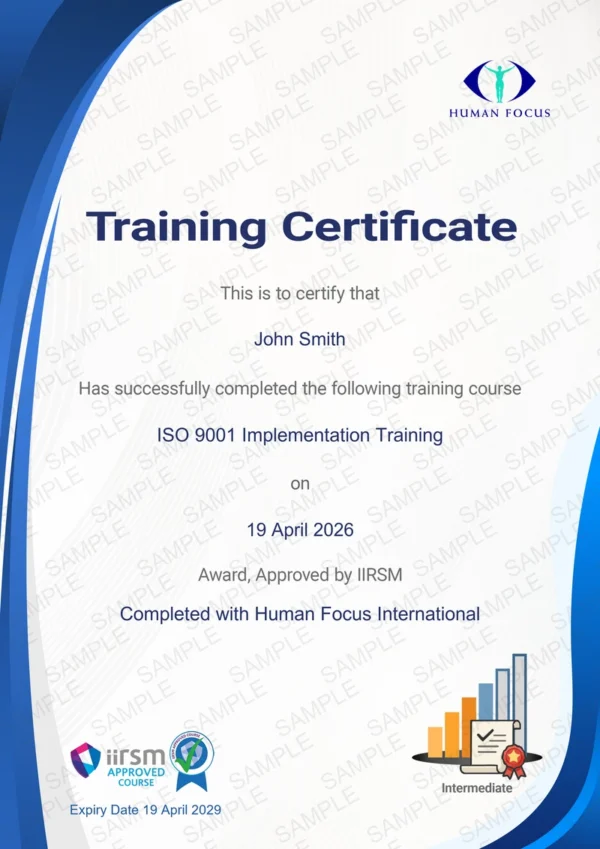
The course certificate includes:
User name
Company name
Course name
Date of completion
Expiry date
Name of the approval body
An IIRSM-approved certificate will be available for download and printing instantly upon course completion.
Users must complete an assessment before earning their certification.
The end-of-course test is:
Fully online
Multiple choice
A score of 80% is required to pass.
ISO 9001 GAP Analysis e-Checklist
The course comes with a free ISO 9001 GAP analysis digital checklist that helps users compare existing processes to the standard’s requirements.
E-checklists can be accessed via any device. They are automatically recorded.
Note – This offer is for one ISO 9001 Implementation Training certificate per trainee who completes this course. This e-Checklist licence is for their use and cannot be transferred or shared by other users.
Terms and conditions apply – access to this e-Checklist is for 12 months from purchase.
Customer Feedback
Why is this ISO 9001 Implementation Training course Important?
Every business has sets of processes for routine tasks. Even if these processes aren’t documented, there’s an accepted way to do everything. Collectively, these processes are referred to as a quality management system (QMS).
ISO 9001 is a globally recognised standard that provides a framework for outstanding quality management systems. It outlines specific requirements for setting up, maintaining and improving quality management systems that ensure products and services consistently meet or exceed customer expectations.
Organisations that have implemented ISO 9001 can choose to apply for certification, which demonstrates a commitment to quality. Customers and stakeholders can trust an ISO 9001-certified organisation has processes in place to ensure the safety, compliance, and quality of its products and services.
This ISO 9001 Implementation Training course equips users with a comprehensive understanding of the ISO 9001 standard and its requirements. It provides an overview of each clause and steps to implementation. Users will understand how to establish a QMS aligned with ISO 9001 standards, ensuring quality across operations and laying the foundations for certification.