This IIRSM-approved Introduction to ISO 9001 training helps organisations quickly build a shared understanding of what ISO 9001 means in practice—essential for achieving, maintaining, or improving certification.
It explains the structure and key clauses of ISO 9001:2015 and uses a realistic case study to show how planning, operational control, performance review, and continual improvement work day to day.
For quality leads or duty holders, this course provides a simple, credible way to strengthen competence across teams and demonstrate that staff understand their role in delivering consistent, customer-focused quality.
live_tv
100% online training
volume_up
Full audio voiceover
repeat_on
Fully online assessment
account_balance_wallet
Discounts when you buy in bulk
important_devices
Access on any device
app_shortcut
App available for iOS & Android
Training You Can Trust
Approved by IIRSM
Aligned with ISO 9001:2015
Certificate on completion
Developed by health and safety professionals
Disclaimer: This course provides an introductory overview of the standard, including its structure, key concepts and general requirements. It does not provide detailed implementation, auditing or certification guidance. How the standard is interpreted and applied will depend on the organisation’s context, objectives, risks, processes and management system arrangements.
This online ISO 9001 course contains the following modules:
Shows what ISO 9001 is and how a Quality Management System (QMS) works in practice. Learners see how the core ideas of processes, planning, checking and improvement connect directly to everyday work.
What is a Quality Management System?
Structure of the ISO 9001 Standard
Process-based Approach
The PDCA Cycle
Key Themes
Explores how organisations meet ISO 9001 clauses 4 to 7 by addressing context, leadership, planning and support. A case study shows how clear direction, practical objectives and sufficient resources help teams work consistently and meet customer expectations.
Context
Leadership
Planning
Support
Demonstrates how clauses 8 to 10 turn quality planning into action, from controlling processes to interpreting feedback and driving improvement. Learners see how these steps maintain reliability and customer confidence.
Operation
Performance Evaluation
Improvement
Disclaimer: This course provides an introductory overview of the standard, including its structure, key concepts and general requirements. It does not provide detailed implementation, auditing or certification guidance. How the standard is interpreted and applied will depend on the organisation’s context, objectives, risks, processes and management system arrangements.
What You Will Learn
The purpose and core principles of ISO 9001 and how they improve product and service quality
How context, leadership and planning create a coherent and effective QMS
The role of competence, communication and resources in supporting consistent performance
How risk-based thinking and quality objectives guide planning and decision-making
How operational control and supplier oversight ensure reliable outputs
How monitoring and continual improvement reduce errors and enhance customer satisfaction
Available in 20+ Languages
Course subtitles are available in multiple languages, including:
This course is approved by the International Institute of Risk & Safety Management (IIRSM).
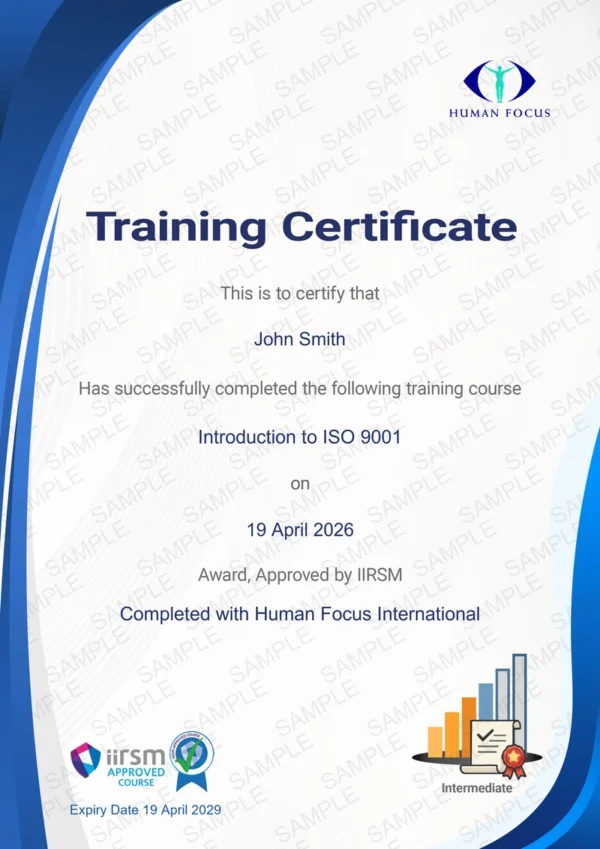
The course certificate includes:
User name
Company name
Course name
Completion date
Expiry date
Approval body
An IIRSM-approved certificate will be available for download and printing instantly upon course completion.
Users must complete a final theory test before earning their certificate.
The end-of-course test is:
Fully online
Multiple choice
A score of 80% is required to pass.
Course attempts
Each licence includes one attempt at the final knowledge assessment.
If a trainee does not pass and wishes to try again, an additional licence is required. For their second attempt, the trainee can retake the assessment without repeating the course content.
Customer Feedback
Why Is the Introduction to ISO 9001 Training Important?
ISO 9001 is a globally recognised framework for designing, controlling and improving the processes that deliver products and services. It links customer, legal and contractual requirements to everyday activities, reducing errors and building trust through consistent quality.
For a quality duty holder or manager, this course provides a practical way to demonstrate organisation-wide understanding of ISO 9001 and lay the foundation for effective certification or improvement programmes. It explains the standard’s seven key clauses (4 to 10) in clear, practical language:
Clause 4 – Context: Shows how understanding your organisation’s context helps teams see how customer needs, risks and process interactions affect quality performance.
Clause 5 – Leadership: Demonstrates how visible leadership and employee involvement create ownership of quality and build confidence in the system.
Clause 6 – Planning: Explores how risk-based thinking and measurable objectives make quality planning more realistic and aligned to business goals.
Clause 7 – Support: Highlights how training, communication and resources enable people to work efficiently and prevent mistakes before they happen.
Clause 8 – Operation: Shows how well-defined processes and supplier control translate planning into consistent, reliable outputs.
Clause 9 – Performance Evaluation: Explains how monitoring and review help identify improvement opportunities and maintain customer satisfaction.
Clause 10 – Improvement: Demonstrates how addressing non-conformities and learning from feedback drive ongoing progress and trust in your brand.
By aligning your people with these principles, the course helps duty holders and quality managers:
Build a baseline of QMS awareness across teams for audit readiness
Show clear evidence of training and understanding to certifiers and clients
Strengthen customer confidence through consistent process control and communication
It turns ISO 9001 from a documented standard into everyday practice, building confidence, consistency and shared ownership of quality throughout the organisation.