Money laundering poses a major threat to both national and global security. The United Nations estimates that $800 billion to $2 trillion in illicit funds are laundered annually. In 2024, Andrew Mitchell, then UK deputy foreign secretary, said that estimates suggested nearly 40% of the world’s laundered money passed through the City of London and UK Crown Dependencies.
Under the Money Laundering, Terrorist Financing and Transfer of Funds Regulations 2017, regulated businesses must adopt a risk-based approach to prevent money laundering. Finance professionals need to identify money laundering risks and take steps to manage them. One of these steps is providing training to employees.
This online Anti-Money Laundering Training programme helps ensure users are aware of money laundering regulations and equipped to prevent, identify and report illegal transactions.
Are You Aware of Your Responsibilities?
Under the Money Laundering, Terrorist Financing and Transfer of Funds Regulations (MLR) 2017, regulated businesses must train relevant employees in how to recognise and respond to money laundering, terrorist financing and proliferation financing risks. This is a specific legal requirement, not a recommendation.
Employers in the regulated sector must:
- Identify and assess money laundering, terrorist financing and proliferation financing risks across the business
- Apply customer due diligence (CDD), enhanced due diligence (EDD) and ongoing monitoring
- Appoint a nominated officer to receive internal disclosures
- Train relevant employees and keep records of that training
- Report suspicious activity through the correct internal and external channels
Businesses that fail to meet these obligations can face unlimited fines, suspension or removal of authorisation, and personal liability for senior managers. Recent supervisor enforcement action shows these powers are applied where staff training and controls fall short.
This online Anti-Money Laundering (AML) Training course helps ensure staff understand the business’s procedures and the responsibilities the MLR 2017 places on the business.
How This Training Helps Your Organisation
This course helps regulated businesses:
- Meet the staff training requirement under the MLR 2017
- Improve consistency in how staff identify and escalate suspicious activity
- Strengthen customer due diligence and ongoing monitoring practices
- Reduce the risk of regulatory breaches, civil penalties and reputational damage
- Provide auditable evidence of training for supervisor inspections and internal audits
Course Features
- Online, self-paced learning accessible at any time
- Compatible with desktop, tablet and mobile devices
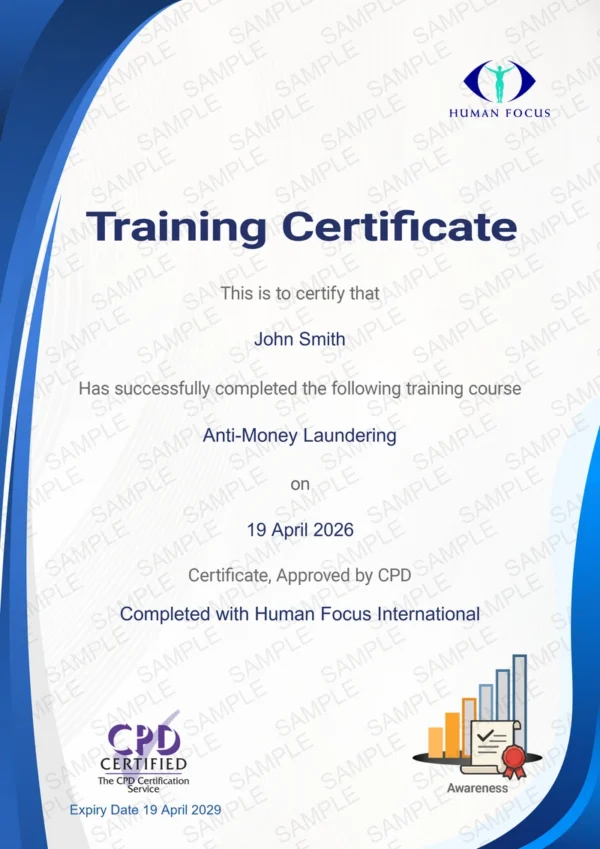
- Downloadable digital certificate on completion
- Training records stored automatically for audit and inspection
- Suitable for company-wide rollout across teams and branches
Certification
Learners who pass the assessment receive an Anti-Money Laundering Training certificate. Training records are stored automatically and can be produced during supervisor inspections or internal audits.
Compliance
This training supports compliance with the Money Laundering, Terrorist Financing and Transfer of Funds (Information on the Payer) Regulations 2017, as amended, which require regulated firms to train relevant employees in how to recognise and respond to money laundering, terrorist financing and proliferation financing risks.
It is suitable for staff working in sectors covered by the MLR 2017, including financial services, accountancy, legal services, estate and letting agency, high-value dealing, trust and company service providers, art market participants and crypto asset businesses.
Start Your Anti-Money Laundering Training Today
Frontline staff are often the first to spot the warning signs of money laundering. Give your team a clear understanding of what the MLR 2017 requires and how to respond to suspicions correctly — and strengthen AML compliance across every team and branch.