How often a fire risk assessment should be reviewed does not depend on a fixed timetable. The Regulatory Reform (Fire Safety) Order 2005 (the Fire Safety Order) requires assessments to be kept up to date, not re-done at prescribed intervals. In practice, this means reviews should be triggered by change — and supported by periodic checks — rather than driven solely by an annual date in the diary.
Under the Fire Safety Order (England and Wales), the Responsible Person must keep a suitable and sufficient fire risk assessment under review. In practice, that means knowing when a light-touch review is enough — and when the premises or activities have changed so much that you are effectively starting again.
This guide focuses on the practical signals that a fire risk assessment no longer matches reality, what “reviewing regularly” looks like as a workable routine (not a calendar promise), and how to carry out a simple, defensible review.
You are responsible for fire safety in a workplace or other non-domestic premises if you are an employer, the owner, the landlord, an occupier, or anyone else with control of the premises. The Fire Safety Order calls them the Responsible Person.
More than one Responsible Person can exist in the same building. In shared premises, Responsible Persons must work together.
As the Responsible Person, you must carry out and regularly review a fire risk assessment of the premises. You must also keep a written record of your fire risk assessment.
The BSA amendments to the Fire Safety Order mean you must now record the fire risk assessment in full, including all findings. This replaces the older requirement where only “significant findings” had to be recorded in some cases.
If you use someone to carry out or review the assessment, you must record their name and, where relevant, their organisation name.
A review does not always mean starting again. Guidance says a fire risk assessment should be kept under review and revised where needed. It also says the assessment needs regular review and updating if there are any significant changes.
Think of it as two levels of work.
PAS 79 is helpful because it forces a simple discipline: what changed, what did you re-check, and why is the assessment still valid? That’s more defensible than relying on a calendar date.
Use this when there have been no meaningful changes and the last action plan was completed.
- Confirm that previous actions were done.
- Verify that nothing significant has changed since the last assessment.
- Walk the escape routes and verify they still work in practice.
- Check controls still work and are maintained.
- Record that the review took place and the date.
The trap is calling something “light-touch” when the building has quietly changed underneath you.
Where changes are minimal, the same PAS 79-based approach used in the original assessment can justify a light-touch review, whereas substantive changes justify a full reassessment — a distinction rooted in methodical risk logic.
Use this when something has changed, when controls are failing, or when the last assessment no longer fits the premises.
PAS 79 and its successor standards embed risk-proportionate thinking into fire risk assessment methodology. That means decisions about review depth and frequency should align with real changes in layout, occupancy, hazards, or controls — not arbitrary dates.
Re-check the core parts of the assessment:
- Fire hazards (what could start a fire, what could burn).
- People at risk, including anyone who may need help to leave.
- Controls you rely on, like detection and warning, escape routes, signs, lighting, and maintenance.
- Evacuation plan, staff knowledge, drills, training, and whether provisions are maintained.
Update the action plan with owners and dates, then record the changes.
Most reviews fail not because nobody cares, but because change happens through small local decisions that never reach the person accountable for the assessment.
Triggers should be observable and defensible: changes to use, occupancy, fire protection, or escape routes should prompt an immediate review.
This aligns with how fire risk assessment frameworks recommend linking change events to review decisions.
Review your fire risk assessment if you suspect it is no longer valid, or if there has been a significant relevant change.
This isn’t usually missed because someone ignored a refurbishment. It’s missed because small changes are treated as “temporary” and never flow back into the assessment: a partition here, a new door set there, a contractor’s cable run through a compartment line.
Review the assessment if the building no longer matches what the assessment describes.
- Refurbishment, extension, re-fit, new rooms, new mezzanine
- Changes to escape routes, stairwells, doors, signage, and emergency lighting
- Compartmentation issues, like new service penetrations or damaged fire stopping
These changes can alter fire spread and evacuation. They can also change what protection measures you rely on.
Fire load rarely increases because people are reckless. It increases because the business changes: stock lines expand, peak delivery days become normal, and storage creeps into escape routes because space is tight.
Review if work activities change. This includes new fire hazards and new fuel loads.
- New equipment or heat sources
- Hot work, changes to maintenance arrangements, contractors on site
- New storage or handling of flammables or dangerous substances, including where and how they are stored
Headcount changes are obvious. The harder shift is evacuation capability: who is new, who is unfamiliar, who needs assistance, and whether the plan still works on nights, weekends, and contractor-heavy periods.
Review if the people on site change, or if they would evacuate in a different way.
- More people on site, different shift patterns, lone working
- Sleeping accommodation, where relevant
- More vulnerable people, or more people who need help to evacuate
If the controls you rely on are degrading — overdue servicing, disabled devices, repeated false alarms — your assessment is already out of date in practice.
- New alarm system, detector changes, disabled devices, overdue servicing
- Changes to staff roles, fire wardens, and training coverage
- Repeated false alarms, test failures, and poor housekeeping trends
Review it after any warning signs. Do not wait for the next planned review date.
- Fire event on site
- Significant near miss
- Fire and rescue service inspection findings, action plans, notices
Review it when duties change, or when guidance shifts what should be covered and recorded.
A clear example is the Section 156 changes. These require Responsible Persons to record the completed fire risk assessment in full and to record the identity of the person or organisation that carried out or reviewed it. That can change what you document when you review or update your assessment.
There is no fixed legal review interval written into the Order. The duty is to keep the fire risk assessment up to date by reviewing it regularly.
Most organisations don’t fall down because they missed an annual date. They fall down because they treated the last sign-off as proof that the controls still hold.
UK fire safety law is largely performance-based, not prescriptive about fixed review intervals. There is no statutory requirement to review a fire risk assessment every 12 months.
The Fire Safety Order requires assessments to be kept up to date, which means reviewed whenever circumstances change. Article 9 requires the assessment to be reviewed regularly, and particularly where it may no longer be valid, or there’s been a significant change.
In practice, that means two things:
- Set a planned review date (so it does not get missed)
- Review sooner if there is reason to suspect it is no longer valid or if something relevant has changed.
In stable, lower-risk premises, an annual review is a common baseline in practice — but it never replaces reviewing on change.
Most professional guidance on review frequency reflects industry best practice rather than legislative obligation. The accepted baseline of an annual review is a common professional recommendation, not a legal mandate. (Mid and West Wales Fire and Rescue Service, 2020)
Some fire and rescue services build this into their templates: “reviewed annually” unless there is a reason to do it earlier.
For higher-risk or fast-changing sites, review more often. Set the cycle based on how often the site changes and the level of risk.
Structuring review intervals solely around past frequencies (e.g., “last reviewed Dec 2024”) without reference to actual changes risks formal compliance but not necessarily suitable and sufficient fire risk management. Fire safety best practice places a higher value on quality and reasoning than on mere frequency.
Use this process for both a light-touch review and a full update — adjust the depth to match the change and risk.
- List what changed since the last assessment: Note changes to the building, people, work, storage, or contractors. Note fires, near misses, and false alarms.
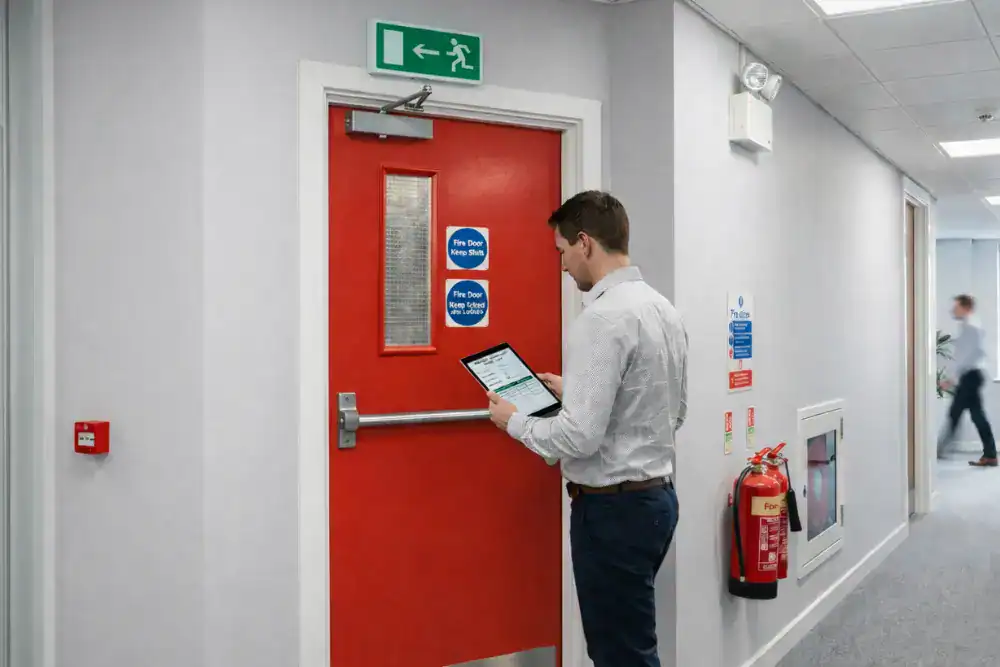
- Walk the building: Do a walk-through at normal working time if you can. Look for changes that did not go through the project process.
- Follow escape routes end to end: Start from the furthest points. Follow routes to final exits. Confirm that exits open as needed and routes stay clear.
- Check controls: Inspect the things the assessment relies on:
- Fire doors and door closers
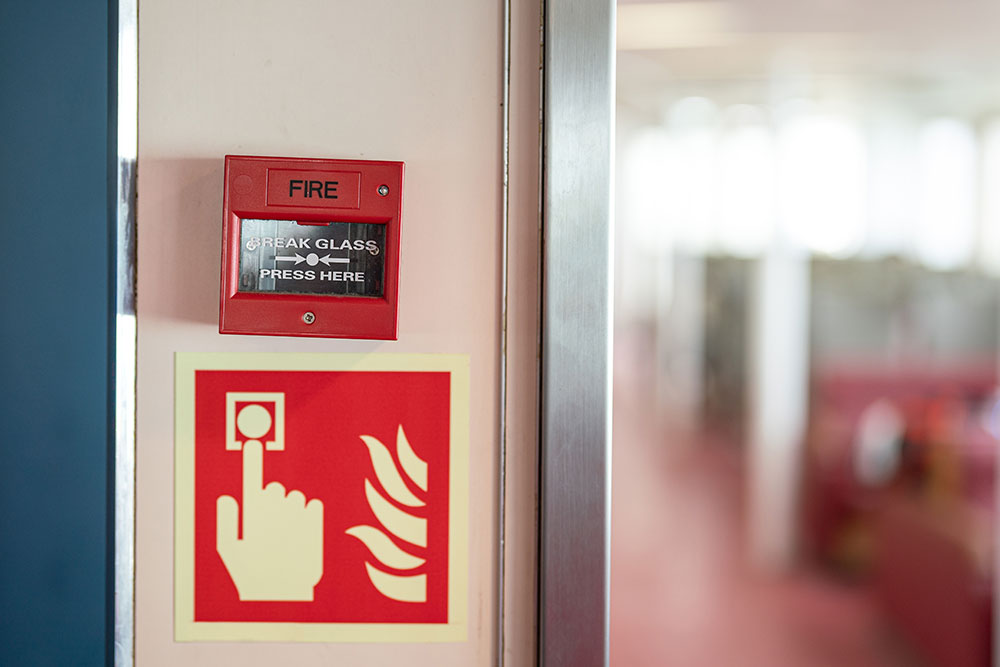
- Alarm and detection devices
- Emergency lighting and exit signs
- Extinguishers and other first aid fire equipment
- Fire stopping and compartment lines where you can see them
- Housekeeping, storage, waste control, ignition sources
- Review records: Pull the evidence that controls are maintained and people are prepared:
- Alarm tests and servicing
- Emergency lighting tests
- Extinguisher inspections
- Fire drills
- Training records
- Action plan items closed out, with dates and proof
- Update findings and the action plan: Write what you found. Set actions with an owner and a due date. Keep it tied to risk and legal duty.
- Brief staff and tenants where it affects them: Tell people what changed, what to do, and what routes or procedures are in place. In shared buildings, make sure other duty holders know what affects their areas.
- Set the next review date and a “review on change” trigger: Put a date in the diary. Also, set a rule that any significant change triggers an early review, not waiting until the next date.
The Responsible Person stays accountable. The duty is to make sure the fire risk assessment is suitable and sufficient, even if someone else does the work.
Home Office guidance notes that a specific legal requirement about assessor competence will come into force later; until then, you’re still expected to ensure any assessor you appoint is competent, because you remain accountable for the assessment being suitable and sufficient.
An in-house review can work for small, low-risk sites. It depends on competence. The assessment can be done in-house using the Government’s official guide for small and medium places of assembly. If there is not enough expertise or time, a competent person should be appointed to help.
In housing contexts, PAS 79-2 has been superseded by BS 9792:2025, reflecting a broader push toward more defensible documentation and risk-proportionate decisions. For non-housing premises, PAS 79-1 remains a common methodology reference — but the principle is the same: document what changed, what you checked, and why the assessment remains valid.
If an external assessor is used:
- Record who carried out or reviewed the assessment. Record their name and, where relevant, their organisation name.
- Verify competence and scope fit. Ensure they have the right training and experience for the type of premises and level of risk.
- Keep notes on selection tests. Government guidance for duty holders recommends keeping records of the steps taken, like experience for similar premises, scope agreed, references, and insurance.
Keep a written fire risk assessment record. The assessment must be recorded in full, including all findings.
Using recognised frameworks (like PAS 79) can make the reasoning behind your review timing more defensible to enforcement officers and insurers than simply noting a date on a calendar. Structured documentation of findings and assumptions is seen as good practice in fire safety professional guidance.
Keep a simple review log:
- Date of review
- Name of reviewer
- What changed since last time
- What was checked
- What was updated
- Next review date
Keep proof that actions were closed out:
- Action plan status
- Photos where useful
- Certificates
- Service and test reports
Keep a record of the assessment that was reviewed and the date it was reviewed.
If an external assessor is used, record their identity.
There is no single fire risk assessment review frequency that fits all premises. The duty is to keep the assessment current. That means setting a planned review date, then reviewing earlier when something changes.
In practice, “review regularly” exists because static assessments degrade as buildings and work patterns evolve — so review frequency is about relevance and validity, not routine completion.
Treat the review as part of normal control. Walk routes. Inspect doors, alarms, signs, lighting, extinguishers, and housekeeping. Check records and close actions. Record what you checked, what you changed, and who did the work.
If you want reviews to be consistent, don’t rely on memory or goodwill. Define what “good” looks like for walk-through checks, make it easy to record findings, and build a simple loop for escalation and close-out.
Training can support that—especially for people doing inspections and checks—but it only works when it sits inside clear standards, task boundaries, and management follow-up.
Human Focus offers a wide range of approved fire safety training courses. These cover fire risk assessment alongside related fire safety inspections and checks, helping organisations build the competence needed to review assessments, carry out routine inspections, and recognise when changes on site should trigger a review.