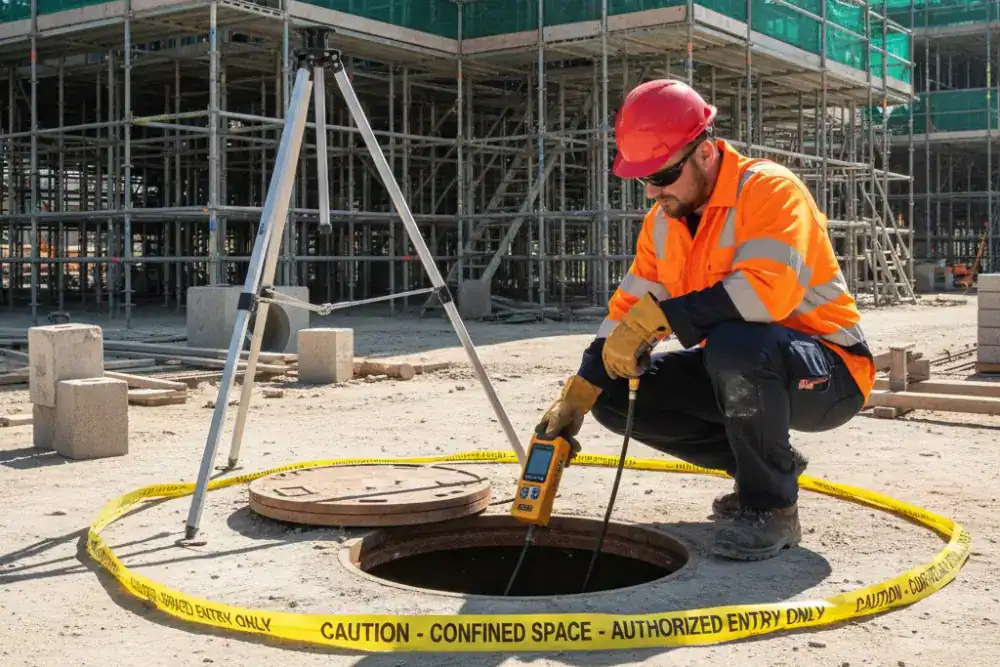
Confined spaces can create lethal conditions for workers. Duty holders must plan the job to confirm a safe atmosphere before entry. This often means setting gas testing and ventilation controls in the safe system of work.
This blog explains what managers and business leaders must put in place to control risks from gases in confined spaces.
What Counts as a Confined Space in UK Law
Under the Confined Spaces Regulations 1997, a confined space has two defining features.
- It is substantially enclosed.
- One or more “specified risks” are present or reasonably foreseeable.
“Specified risks” include:
- Fire or explosion
- Loss of consciousness due to heat
- Loss of consciousness or asphyxiation from gas, fume, vapour or lack of oxygen
- Drowning from rising liquid
- Asphyxiation or entrapment from a free-flowing solid
A space can become a confined space due to the work being carried out. It may no longer be a confined space once the risk is removed and the atmosphere is confirmed safe. Controls need to be checked throughout the task to ensure conditions remain safe.
Why Air Turns Dangerous Fast
Confined spaces have restricted airflow. This allows gases and vapours to build up and linger. Oxygen levels can also fall or rise, which can affect breathing safety and fire risk.
HSE’s Approved Code of Practice (ACOP) highlights factors that can make air inside a confined space dangerous, including:
- Disturbed chemical residues
- Contamination from adjacent sites or processes
- Hazards created by the work (e.g., cleaning chemicals)
Duty holders must include these factors in their confined space risk assessments. If an atmospheric risk is present, the plan must include testing before entry and re-testing or continuous monitoring where conditions can change.
Setting Up Gas Testing Procedures
Gas testing shows whether the atmosphere is safe at the time of testing for the intended work, duration, and controls.
Where there is doubt or where knowledge of the space suggests the air may be unsafe, the atmosphere must be tested before entry. This includes checking the oxygen concentration and the presence of hazardous gases, fumes, or vapours.
1. When to Test
Test before anyone enters when there’s a realistic risk the atmosphere is unsafe, or when the risk assessment says so.
Test again after purging or ventilation changes. HSE states that after purging, it’s essential to test and confirm the air is safe to breathe before entry.
Test again if the job changes. Cleaning chemicals, hot work, disturbed residues, and engines outside the space can change the atmosphere during the job.
If there’s a risk of unsafe atmospheric conditions during the job, workers should be provided with continuous gas monitoring equipment.
2. Who Should Test
Testing should be carried out by people who are competent in the practice. They must know the standards for the contaminants being measured and must be able to interpret results and take action. Records should be kept of results and findings.
3. Test Order and Why It Matters
The ACOP sets the following testing order:
- Measure oxygen first
- Then test flammable gases
- Then test toxic gases, vapours and dusts
This order reduces the chance of a ‘clean’ reading that hides a serious risk. If oxygen is low, workers can lose consciousness.
An oxygen level higher than the normal 21% is also dangerous as it increases fire risk. The HSE warns that even an increase to 24% oxygen can make fires easier to start, burn hotter and nearly impossible to put out.
4. Sampling: Test the Whole Space, Not Just the Opening
Different gases can be present at different locations in a confined space:
- Gases heavier than air can sink to the bottom of spaces
- Gases lighter than air can rise to the top of spaces
- Gases with a density similar to air can disperse everywhere
Gases can also accumulate in “pockets,” such as partially closed areas that are located slightly lower or higher than the rest of the space.
Pre-task gas tests must check different points at different levels throughout the confined space. This can often be tested from outside by drawing samples through a long probe.
This is a common failure point. Teams test at the top manway, get a clean reading, then climb down into a low pocket where heavy vapour sits. What matters is not whether testing happened, but whether samples were taken where people will breathe and work.
5. After a “Good” Reading: What Managers Should Still Ask
A good reading only means “good” for the measured hazards, at the measured points, at that time, for that planned work.
A manager should still ask:
- What hazards were expected from the last contents, residues and nearby plant?
- What sensors were used, and what are they set up to detect?
- Where was the sample taken, and how long was the line purged before the reading?
- What will change the atmosphere during the job?
- What will trigger a stop, evacuation and re-test?
Those questions belong in the safe system of work and, where needed, the permit-to-work.
Setting up Ventilation Controls
If an atmospheric risk is present in a confined space, ventilation controls may be required to achieve and maintain safe conditions for work. Ventilation reduces the build-up of gases, vapours and fumes and supplies fresh air.
Natural Ventilation vs. Forced Ventilation
Some confined spaces need mechanical ventilation. This can be done using a blower fan with trunking, an exhaust fan or ejector with trunking, or both, provided there is an adequate supply of fresh air to replace used air. Fresh air should be drawn from a point where it is not contaminated.
Natural ventilation may be enough where there are top and bottom openings. HSE gives an example: a small tank with heavy vapour and a single top manhole may need exhaust from the bottom with make-up air entering through the manhole.
A fan does not make the space safe. Air must circulate where people enter and work.
Supply, Extract and Ducting
Managers must consider the layout, openings and pollutant properties when choosing ventilation, so circulation is effective. For spaces where gas pockets may collect, a more complex system may be needed, including a combination of supply and exhaust.
Extract ventilation should be routed away from potential re-entry points and to a location that will not create additional risks. Ducting or trunking should extend to the bottom of the vessel to remove heavy gas or vapour and to support circulation. Trunking should not hinder entry or exit.
This drives practical decisions:
- Put the supply intake where it cannot pull in exhaust, welding fume or vehicle emissions
- Put the extract discharge where it will not blow back into the work area or into other openings
- Put duct ends where the hazard sits, often low in the space
Never “Sweeten” the Air with Oxygen
HSE states that oxygen must never be added to a confined space to improve the atmosphere. Adding oxygen can cause oxygen enrichment and increase the risk of fire.
If the job cannot be made safe through ventilation and isolation, controls should move to breathing apparatus and rescue arrangements. Oxygen should not be used as a substitute for proper atmospheric controls.
Purging and What it Does to Everyone Else
Where the risk assessment identifies flammable or toxic gases or vapours, purging may be needed. Purging can be done with air or an inert gas where toxic contaminants are present. Where flammable contaminants are present, inert gas may be required because purging with air can create a flammable mixture. After purging, test the atmosphere before entry.
Managers must also assess exposure from vented gases during purging. Controls must protect people outside the space.
This is often overlooked. Ventilation and purging move hazards. They do not erase them. The discharge can poison a nearby work crew or drift into an intake.
Making Controls Stick: Training, Permits, Supervision and Monitoring
Gas testing and ventilation only work when they sit inside a managed system.
Training: The Competence Managers Must Verify
Confined space work fails when people do not understand the risks, the kit, or the stop rules. Training must match the job. It must be site-specific. It must prove competence, not attendance.
Set training by role:
- Entrants: hazards, entry limits, PPE and RPE, communications, stop-work triggers
- Gas testers: instrument limits, sampling points, test order, calibration checks, action on alarms
- Ventilation set-up: intake and discharge placement, duct routing, dead zones, checks during the job
- Standby person: watch duties, communications, permit limits, and raising the alarm
- Supervisors: permit control, isolations, control checks, stopping work, handovers
- Rescue team: rescue plan, rescue kit, drills, no-entry rescue where possible
Train on the site process:
- Risk assessment and permit-to-work steps
- Isolation and lock-off checks
- What to do if readings change
- What to do if ventilation fails
- Emergency actions and rescue call-out
Refresh training and run drills. Do this when the job changes, kit changes, or the team changes. Keep records. Use audits to check that people follow the process on site.
Permit-to-Work: The Control Record, Not the Control Itself
A permit-to-work system is a formal written system used where there is a foreseeable risk of serious injury. It is an extension of the safe system of work, not a replacement. It supports the safe system by recording findings and authorisations. It can include time limits on entry, results of gas testing and information needed during an emergency.
So, for confined space gas testing and ventilation, the permit should make the job stoppable. It should say:
- What “safe” readings are for this task
- What ventilation is required, and how it will be set up
- What triggers a stop, exit and re-test
- Who has the authority to cancel the permit when conditions change
Monitoring During the Job
Actions taken to mitigate risk should be monitored to ensure they work and continue to work throughout the task.
For managers, that means planning for drift. Fans get moved. Ducts get crushed. A vehicle starts nearby. Residue gets disturbed. The job plan should expect that and include checks after any change to ventilation or the job.
Emergency and Rescue Arrangements
The law requires sufficient emergency rescue arrangements to be in place before anyone enters or works in a confined space.
The ACOP notes that emergency arrangements should include provision for extracting workers and first-aid equipment, including resuscitation equipment, where the need can be foreseen.
According to the HSE, Many deaths and injuries happen when people enter to rescue others without proper training and equipment.
If a site’s “rescue plan” is “call the fire brigade”, then the plan is not in place. The job should not start.
Conclusion — Reliable Atmosphere Control Comes From a Safe Work System
Gas testing and ventilation do not break down because one worker misses a step. They fail when the job is set up with no clear stop rule as conditions change. Readings can vary. Fans can fail or get moved. New fumes can enter from the task or nearby activity.
Reliable control comes from planning the work around the reality of confined spaces. Managers need a defined testing approach that states what will be measured, where samples will be taken, and when re-testing or continuous monitoring is required.
Human Focus supports organisations that need this level of control. Our confined space training equips workers with an essential awareness of the hazards and risk controls of confined space work. You can assign this course directly to staff within the Human Focus LMS available on desktop and mobile devices.