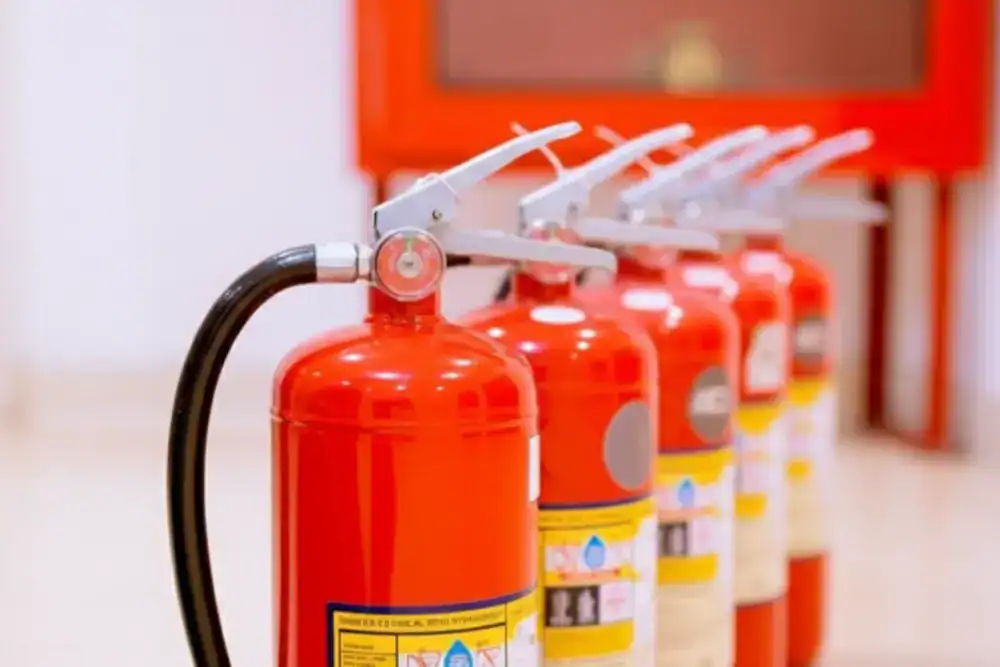
In a real fire, people don’t have time to read labels. In smoke, noise and pressure, they need to recognise the right fire extinguisher instantly — because using the wrong type can make the situation far more dangerous.
CO₂ fire extinguishers are a common sight in offices and commercial buildings, often positioned near electrical equipment. But despite their familiarity, they’re only effective in specific situations.
This guide explains when a CO₂ fire extinguisher should be used, when it must not be used, and how to use it safely.
Fires are classified based on what is burning, not what the fire looks like. This distinction matters because fire extinguishers are designed to deal with specific fuels, and using the wrong type can be ineffective or actively dangerous.
Common fire classes include:
- Class A – Fires involving solid materials such as wood, paper or textiles.
- Class B – Fires involving flammable liquids such as petrol, solvents and some oils.
- Class C – Fires involving flammable gases.
- Class D – Fires involving combustible metals.
- Electrical fires – Fires involving live electrical equipment.
- Class F – Fires involving cooking oils and fats.
Understanding these classes is essential because extinguisher suitability is based on fuel type. A fire in an office, kitchen or workshop can fall into different classes and require very different responses.
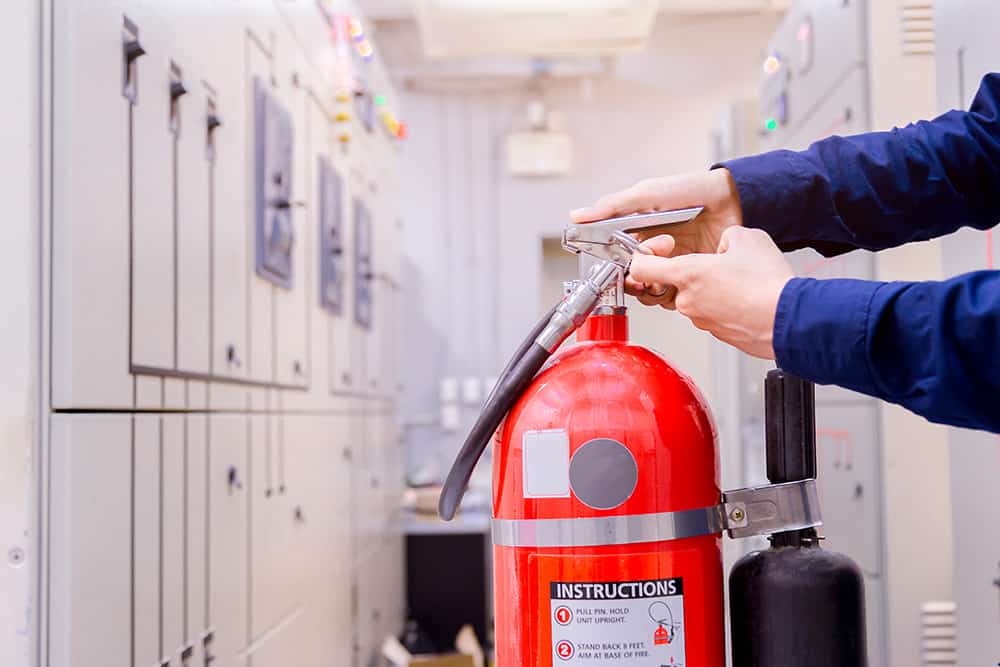
Carbon dioxide fire extinguishers are commonly used on fires involving live electrical equipment, such as computers, servers or electrical panels.
Because CO₂ is non-conductive, it reduces the risk of electric shock when used correctly. It also leaves no residue behind, which helps prevent damage to sensitive equipment and reduces clean-up after the incident.
For this reason, you will often find CO₂ extinguishers in offices, control rooms and other environments with electrical risks.
CO₂ extinguishers can also be used on Class B fires, which involve flammable liquids such as petrol, oils or solvents.
In these cases, the carbon dioxide suppresses the fire by displacing oxygen around the flames. However, CO₂ does not cool the fuel, so there is a risk of re-ignition if the heat source remains.
Because of this limitation, CO₂ extinguishers are generally most effective on small, contained Class B fires where the fuel source can be controlled quickly.
CO₂ fails or becomes unsafe on the following fires:
- Class A – CO₂ does not penetrate solid materials, so the fire may restart once the gas disperses.
- Class D – Burning metals can react with CO₂, increasing heat or causing sparks.
- Class F – CO₂ cannot cool hot cooking oils, allowing the fire to continue or spread.
- Open or Outdoor Fires – Wind quickly disperses the gas, preventing it from smothering the flames.
CO₂ extinguishers should only be used where the gas can remain concentrated around the fire long enough to interrupt the oxygen supply.
A CO₂ extinguisher works by releasing carbon dioxide gas at high pressure. The gas spreads over the fire and displaces oxygen, which the fire needs to keep burning. By reducing the oxygen around the flames, the fire is suppressed.
Unlike some other extinguishers, CO₂ does not contain water or powder. This means it leaves no residue behind, making it suitable for use near sensitive electrical equipment.
However, because CO₂ does not cool the burning material, it is most effective on small, contained fires where the risk of re-ignition is low.
Before using a fire extinguisher, it’s important to confirm it is the correct type.
You can identify it by the following features:
- A black label around the body with “CO₂” written in large white letters.
- A large black horn-shaped nozzle, designed to protect the user’s hands from cold burns caused by the discharge of extremely cold gas.
- A CO₂ fire extinguisher sign displayed nearby.
CO₂ fire extinguishers should only be used by people who have received basic fire safety instruction or training and understand when it is safe to attempt to tackle a fire.
In most workplaces, employees are not expected to fight fires as a primary response. Fire extinguishers are provided to support safe evacuation and may be used on small, early-stage fires where it is safe to do so.
A CO₂ extinguisher may be used if:
- The fire is small and contained.
- The extinguisher is suitable for the fire type.
- The person using it has been instructed or trained.
- There is a clear escape route at all times.
Anyone who is unsure, untrained or feels at risk should not attempt to use a fire extinguisher and should evacuate immediately. Personal safety must always take priority over property or equipment.
Only use a CO₂ fire extinguisher if the fire is small, there’s a clear escape route and the extinguisher is suitable for the fire type.
Follow these steps:
- Pull the safety pin. This breaks the tamper seal and allows the extinguisher to operate.
- Aim the horn at the base of the fire. Keep a safe distance (at least one metre) and do not hold the horn, as it becomes extremely cold during use.
- Squeeze the handle to release the carbon dioxide.
- Sweep the horn side to side. Direct the gas across the base of the flames until the fire is out.
Most CO₂ extinguishers empty in under 10 seconds. You must act fast.
After use, ventilate the area as soon as possible, as CO₂ can displace breathable oxygen in enclosed spaces.
In the UK, workplace fire safety is governed by the Regulatory Reform (Fire Safety) Order 2005, which applies to most non-domestic premises.
Under this law, the responsible person, typically the employer, building owner or manager, has legal responsibility for fire safety.
They must:
- Carry out a fire risk assessment.
- Identify appropriate fire-fighting equipment for the risks present.
- Ensure fire extinguishers are maintained, inspected and clearly identified.
- Provide employees with fire safety information and training.
The law does not require specific extinguisher types by default. Instead, it requires that any fire extinguisher that is provided (including a CO₂ extinguisher) is suitable for the fire risks identified and supports safe evacuation.
The following recognised fire safety standards provide detailed guidance on choosing, placing and maintaining fire extinguishers:
- BS 5306-8 covers the selection, positioning and maintenance of fire extinguishers, including when CO₂ extinguishers are appropriate for electrical risks.
- BS EN 3 sets requirements for the manufacture and performance of portable fire extinguishers, helping ensure they are safe, consistent and clearly identifiable.
For duty holders, these standards matter because they define what “suitable” looks like in practice – from where CO₂ extinguishers are positioned to how they’re maintained and identified.
Knowing which fire extinguisher to use is only part of fire safety. In a real emergency, you also need the confidence and practical understanding to act quickly and safely.
We offer an online fire extinguisher training course that will help you:
- Understand different fire classes and types of fire extinguishers.
- Recognise when it is safe to tackle a fire and when evacuation is the right option.
- Learn how to identify and use the right type of extinguisher.
If you want to feel confident using the right extinguisher at the right time, fire extinguisher training is the simplest next step. Enrol today!