Back pain is one of the most common reasons employees take extended time off work. This IIRSM-approved Back Care Management in Offices for Managers course helps managers understand why back pain leads to absence and what they can do to prevent it.
The course covers the evidence-based approach to back pain management, the manager’s role in supporting early recovery, and how effective communication and practical workplace adjustments help keep employees active and at work.
This course is designed for managers and supervisors in office-based environments who are responsible for supporting employees experiencing back pain, including:
Line managers and team leaders
Operations managers
HR and people managers
Health and safety managers
Office and facilities managers
Supervisors responsible for employee welfare and absence management
Course Content
This course includes the following sections:
Understand how common back pain is, why serious underlying causes are rare, and how modern research has changed the way it should be managed. Learn why physical demands are not always the primary cause of absence.
Understand why staying active and remaining at work leads to faster recovery. Recognise how early management action prevents back pain becoming a significant absence problem.
Learn how conflicting advice from different sources creates obstacles to recovery. Understand how managers can confidently reinforce evidence-based guidance and support employees who may have received unhelpful information.
Know how to make temporary, time-limited adjustments to tasks and duties that allow employees with back pain to stay at work or return before they are fully pain free. Understand how to prevent these adjustments drifting on indefinitely.
Understand how to set agreed, realistic recovery targets with employees. Recognise the role of psychosocial factors — including stress and workplace relationships — in back pain absence, and how addressing them supports a faster return to full duties.
Learn how tone, body language and listening skills influence whether employees feel comfortable raising concerns and returning to work. Understand how to approach sensitive conversations in a way that conveys genuine support.
What Your Staff Will Learn
By completing this training, managers will understand:
Why back pain leads to absence and why the modern approach to recovery differs from common assumptions
How staying active and remaining at work leads to faster recovery than rest or extended absence
How to identify and address psychosocial factors — such as job stress, workplace relationships and low job satisfaction — that contribute to back pain absence
How to apply the three principles of back pain management: maintaining a consistent message, facilitating quick recovery, and agreeing on recovery goals
How to make temporary, time-limited workplace adjustments that support employees with back pain
How communication style and tone affect an employee’s willingness to raise concerns and return to work
How to make early contact with absent employees in a way that supports recovery rather than creating pressure
Available in 20+ Languages
Course subtitles are available in multiple languages, including:
This course is approved by IIRSM – the International Institute of Risk & Safety Management.
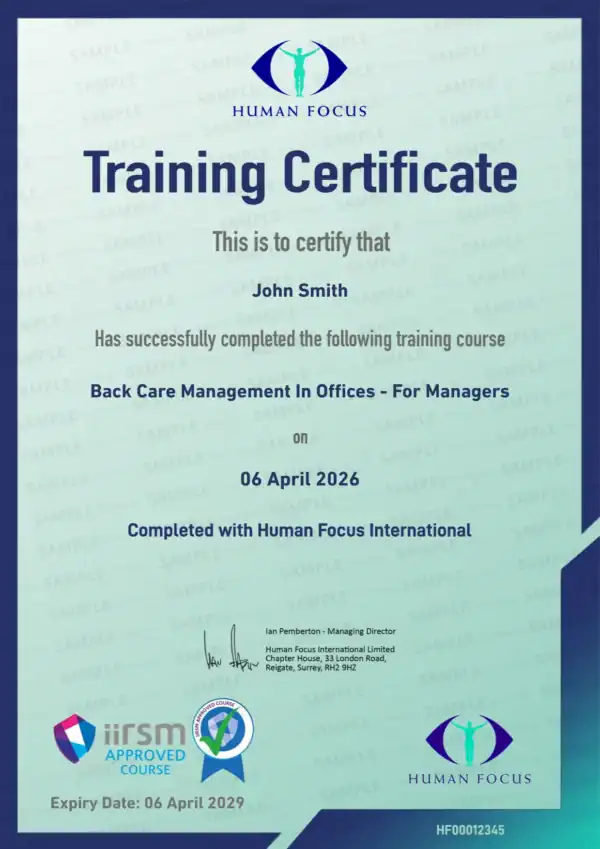
The course certificate includes:
User name
Company name
Course name
Completion date
Expiry date
Approval body
An IIRSM-approved course certificate will be available for download and printing instantly upon course completion.
Users must complete a final theory test before earning their certificate.
The end-of-course test is:
Fully online
Multiple choice
A score of 80% is required to pass.
Customer Feedback
Why This Training Is Important
Back pain is consistently one of the leading causes of long-term sickness absence in UK workplaces. The direct costs are significant, but the indirect costs — reduced productivity, team disruption and the difficulty of managing extended absence — are often greater.
Research consistently shows that employees who remain active and continue working recover faster than those who rest or take extended time off. Yet many workers — and some managers — still believe that rest and absence are the appropriate response to back pain.
Psychosocial factors, including job stress, difficult workplace relationships and low job satisfaction, are recognised by the Health and Safety Executive as significant contributors to back pain absence. These factors are as important to address as the physical symptoms.
Managers play a critical role. How they respond when an employee reports back pain — the message they give, the adjustments they make and the way they communicate — directly influences whether that employee stays at work or goes off, and how quickly they recover.
Training ensures managers are equipped with the right approach, rather than relying on outdated assumptions that can unintentionally make the problem worse.
How This Training Helps Your Organisation
This course helps organisations:
Reduce back pain-related absence by equipping managers to intervene early and effectively
Improve consistency in how back pain cases are handled across teams and line managers
Ensure managers understand and apply the evidence-based approach to back pain recovery
Strengthen return-to-work processes through structured goal-setting and temporary adjustments
Support a workplace culture where employees feel comfortable raising health concerns early
Get Started
Give your managers the knowledge and skills they need to handle back pain effectively in the workplace. This training helps reduce absence, supports earlier recovery and ensures your managers respond consistently and confidently when employees raise concerns. Enrol your management team today.