Injuries from needles and other sharps are a serious risk when they are not disposed of safely. These incidents put healthcare workers, patients, carers and the public at risk of infection and injury.
Safe disposal of sharps is essential to prevent needlestick injuries, protect waste workers and keep communities safe. It is also a legal requirement across healthcare and other professional settings.
This guide explains why safe disposal of sharps is important, the correct procedures to follow and the legal duties that apply to both individuals and organisations.
In health and safety terms, a sharp is any object with a point or edge capable of puncturing or cutting the skin. In medical environments, this typically includes needles, syringes, lancets and scalpels. In other workplaces, sharps may also mean razors, tattooing equipment or broken glass.
For safety, the following must always be treated as sharps:
- Needles, including those used for injections, blood collection or insulin pens.
- Tattoo and piercing needles, including single-use and disposable types.
- Scalpels and surgical blades, used in clinical or care procedures.
- Lancets, commonly used for glucose testing or blood sampling.
- Syringes, with or without attached needles.
- Razors and knives that are sharp enough to pierce skin.
- Scissors, particularly those used in clinical or care settings.
- Contaminated broken glass, such as shattered vials or specimen tubes.
- Metal wire, including surgical wire or sharp-edged crafting materials.
- Pins, staples and tacks, if used in areas where contamination is possible.
Recognising what counts as a sharp is the first step in safe disposal. When uncertain, it is always safer to treat an item as sharp and dispose of it accordingly.
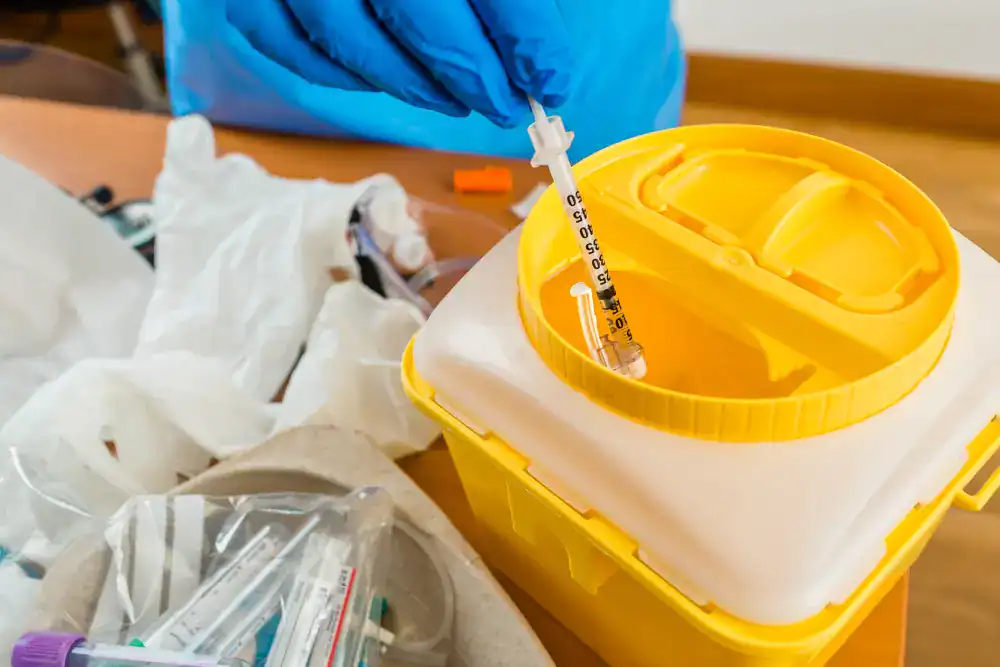
Safe sharps disposal starts with proper handling and the use of purpose-built containers. These are made of hard plastic, are puncture-resistant and lock securely once sealed.
Every sharp must be placed directly into a container at the point of use. Containers should never be overfilled. Once they reach the marked fill line, usually three-quarters full, they must be sealed and stored securely until collected.
Sharps should never be recapped, bent or passed from hand to hand. Once placed inside a container, they must not be removed under any circumstances.
The only safe and approved method for disposing of sharps is to place them in a sharps container.
In the UK, these containers are colour-coded so that different types of sharps can be identified and managed correctly:
- Purple Lid: For sharps contaminated with cytotoxic or cytostatic medicines, such as chemotherapy drugs.
- Yellow Lid: For sharps contaminated with other medicines, such as standard injections.
- Orange Lid: For sharps not contaminated with medicinal products and their residues, including blood testing needles, scalpel blades and contaminated broken glass. This also includes non-pharmaceutical sharp objects such as tattoo or piercing needles.
Sharps containers must always be clearly labelled, kept out of reach of children and pets and positioned at the point of use. This ensures that items can be disposed of immediately after use, without delay or unnecessary handling.
In hospitals and clinics, sharps disposal is carried out by trained staff under strict safety procedures. This means placing every used item directly into a sharps bin at the point of use, sealing containers before they become overfilled and arranging licensed collections.
At home, people managing long-term conditions like diabetes, fertility treatment or hormone therapy must also follow safe disposal practices. The disposal of needles and other sharps is supported by NHS services and local councils, which often provide sharps bins free of charge, usually available on prescription from a GP. Once full, these bins can be returned through council collection schemes, pharmacy drop-off points or local exchange services.
For community carers and staff in residential care homes, workplace policies are essential. Access to sharps bins, clear reporting procedures and regular training are essential in these settings to ensure the safe disposal of needles and other sharps.
Sharps risks are not limited to healthcare. Businesses such as tattoo studios, piercing shops and acupuncture clinics also generate sharps waste. By law, these industries must treat sharps as hazardous clinical waste and arrange disposal through licensed contractors.
Tattoo and piercing studios must place used needles, razors and other sharps into yellow-lidded bins immediately after use. Full containers should be stored securely until collection and accompanied by proper waste transfer documentation.
Acupuncture clinics must dispose of every needle after a single use, even if it appears sterile. Used items must go directly into an approved sharps container, which is then collected by a licensed contractor. Accurate records of these collections should be maintained to demonstrate compliance with health and safety regulations.
Although the needles used in tattooing or acupuncture may be smaller than those in medical settings, the risks of injury and infection remain the same.
Disposal does not end when a sharps bin is sealed. Once full, it must be returned through an approved collection or drop-off service. The available routes vary depending on where the sharps were used:
- NHS and Pharmacy Schemes: Many pharmacies accept full sharps bins and may provide replacements at the same time.
- Local Council Services: Councils often run clinical waste services, which can include home collection or drop-off points.
- GP Surgeries and Health Clinics: Some practices accept sharps bins from registered patients, but this should always be checked in advance.
- District Nurses or Local Public Health Teams: In remote or rural areas where schemes are limited, disposal may be arranged through district nurses or local public health teams.
- Clinical Waste Contractor Services: Private and residential care settings must use licensed clinical waste contractors, keep disposal records and follow compliance checks.
At no point should a sharps bin be placed in general waste. Doing so creates serious risks for waste handlers, local authorities and the public.
Sharps injuries can happen in any setting where contaminated items are used, stored or discarded. While healthcare settings are the most common, risks also exist in care homes, tattoo studios, cleaning services and public spaces.
Used needles and other sharps can carry blood-borne pathogens, including hepatitis B, hepatitis C, HIV and tetanus. Accidental exposure, particularly through needlestick injuries, may result in infection.
The risk is not limited to clinical staff. Refuse collectors, cleaners, carers and members of the public may be exposed when sharps are placed in household bins or discarded in public spaces. Children are especially vulnerable in these environments.
Sharps that enter general waste streams also put waste handlers at risk. Workers sorting materials may suffer injuries or contamination incidents during routine tasks.
UK law places clear responsibilities on employers to protect workers and the public from injuries caused by sharps. The duty to manage these risks is set out in several key regulations.
The Health and Safety at Work Act 1974 requires all employers to ensure, as far as reasonably practicable, the health and safety of their employees and others who may be affected by their work.
The Control of Substances Hazardous to Health (COSHH) Regulations 2002 apply wherever workers could be exposed to biological hazards. This includes any situation where sharps may carry blood or other potentially infectious material. Employers must assess the risk and implement control measures, such as safe disposal procedures and staff training.
The Health and Safety (Sharp Instruments in Healthcare) Regulations 2013 apply specifically to healthcare providers, including hospitals, nursing homes and services delivered in people’s own homes. Under these regulations, employers have additional duties, which require them to:
- Avoid unnecessary use of sharps where safer alternatives are available.
- Prohibit the recapping of needles due to the high risk of injury.
- Provide safer sharps equipment, such as retractable or shielded needles, where reasonably practicable.
- Ensure staff are trained in safe use and disposal procedures.
- Put arrangements in place for immediate medical treatment and follow-up in the event of a sharps injury.
The law requires employers to assess the risks of sharps injuries and put suitable controls in place. One of the most effective ways to meet this duty is by ensuring that staff receive proper training.
Anyone who handles sharps or may come across them during their work needs to understand the risks and how to manage them safely. This includes staff who use sharps directly, handle them after use or encounter them during cleaning or waste disposal.
Our RoSPA-assured online sharps training course explains what counts as a sharp, the risks, the safe use and disposal of sharps and what to do if a sharps injury happens. The course gives workers in healthcare, care services, cleaning, waste handling, laboratories and tattooing and piercing facilities clear guidance for day-to-day tasks and helps employers show they have provided suitable information, instruction and training.
Enrol your staff today to give them the knowledge they need to manage sharps safely and keep your workplace compliant.