Most workplaces have foam fire extinguishers installed, serviced, and signed off. On paper, the control looks straightforward. In practice, foam is one of the most frequently misused extinguisher types, not because people lack information, but because the system around the extinguisher makes correct selection and safe stopping harder than it needs to be.
Mixed extinguisher banks, weak visual cues, outdated risk assumptions, and unclear stop rules force people to make fast, high-stakes decisions under pressure. In those conditions, relying on memory or training alone is fragile. The predictable result is wrong-media use, late intervention, or attempts to fight fires that have already exceeded first-aid limits.
This guide explains where foam fire extinguishers genuinely work, where they do not, and why organisations continue to see misuse even when equipment is present and training records are complete.
It focuses on foam as a system-managed control (tied to fire behaviour, placement, visual discrimination, decision boundaries, and the fire risk assessment) rather than as a test of individual recall during an emergency.
A foam fire extinguisher uses a water-based solution with a foam-forming additive. When discharged, it creates a foam blanket over the burning material or liquid surface. That blanket helps suppress flammable vapours and reduce the oxygen available at the fuel surface, while the water content also cools the fire.
Foam extinguishers are typically used where there is a Class A risk (solid combustibles) and a limited Class B risk (flammable liquids). You often see them in offices, warehouses, factories, garages, and hotels, especially where common combustibles are present alongside small amounts of liquid fuel.
How to identify one on-site:
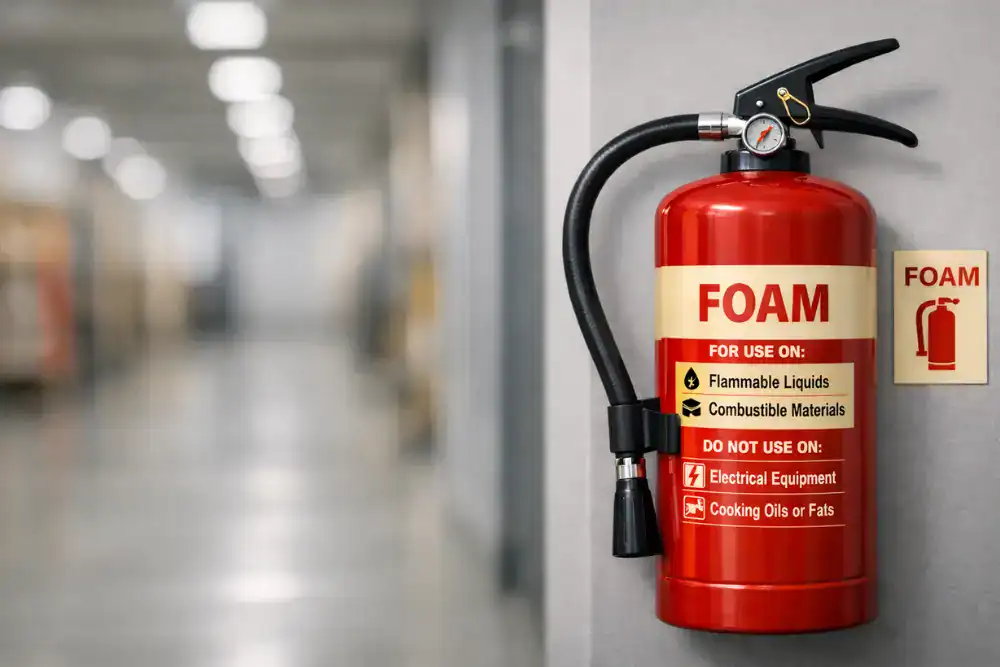
- UK (BS EN3): A red body with a cream band indicates foam. Many also include a cream “Foam” label and a nearby ID sign.
- Outside the UK: Colour bands and signage conventions vary. Always rely on the label and fire-class pictograms on the extinguisher itself, not colour alone.
Class A fires involve solid materials. They often leave glowing embers. Common fuels include paper, wood and textiles. Foam cools the burning material and smothers the fire by covering the surface.
Class B fires involve flammable liquids. This includes petrol, solvents, diesel and paint.
Flammable liquids are liquids that give off vapours that can ignite. Foam helps by sealing in those vapours.
Foam works best on liquid fires where the fuel is pooled and not flowing. For flowing liquid fires, foam may not hold. Dry powder or carbon dioxide (CO₂) may be used, depending on the fire and what is available.
Most workplaces can show that extinguishers are installed, serviced, and covered by training. What is harder to demonstrate is whether correct selection and safe use will hold when conditions are degraded.
Kuligowski’s NIST review describes a behavioural process where people perceive cues, interpret the situation and risk, decide, then act (Kuligowski, 2009).
Crucially, the cues people are processing can include perceived uncertainty, information overload, and time pressure (Kuligowski, 2009).That means mis-selection is often a system outcome. If your setup requires careful discrimination and calm judgement in a moment designed to destroy both, the failure is predictable.
Many checks confirm the extinguisher is there and serviceable. Fewer checks test whether the control is usable and correctly selected in practice.
The pattern usually looks like this:
- Inspections confirm condition and location.
- Training records confirm attendance.
- Selection and decision boundaries are not tested in realistic conditions.
- Gaps surface late, often during an incident.
Work changes faster than equipment layouts. Storage moves, processes shift, contractors introduce new materials, and temporary work becomes routine. Extinguisher provision often stays aligned with an older picture of risk.
The result is predictable:
- The bank looks correct on paper, but no longer matches local hazards.
- People reach for what is nearest, not what is most suitable.
- Misuse is treated as an individual error rather than a change management issue.
Extinguisher selection often depends on fast visual discrimination. London Fire Brigade guidance notes that extinguishers are signal red and the identifying colour zone may be limited, with foam shown as pale cream (London Fire Brigade, 2025). In mixed banks, small identifiers are easier to miss, especially when visibility and attention are reduced.
You tend to see this when:
- Extinguishers look broadly similar at a glance.
- Labels and pictograms are not legible from normal approach distances.
- Lighting, glare, smoke, or crowding reduces cue quality.
Technique is not the main challenge. The main challenge is deciding whether it is still safe to attempt first-aid firefighting.
London Fire Brigade guidance emphasises smoke and toxic fumes as key dangers, and that extinguishers should only be used on small contained fires with evacuation prioritised when use is not safe (London Fire Brigade, 2025). That means the control depends on clear boundaries, not just correct handling.
In practice, people are making rapid calls such as:
- Is this still small and contained?
- Is smoke or heat already making this unsafe?
- Do I have a clear exit route that stays clear?
If training focuses mainly on operation, people can perform the steps and still make the wrong decision. OSHA is explicit that where employees may use extinguishers, they should be educated on the principles and practices of use and the hazards of fighting small or developing fires (OSHA, n.d.).
When limits and hazards are not treated as core content:
- People overestimate what extinguishers are for.
- Stop rules are treated as an optional judgement rather than expected behaviour.
- The organisation mistakes competence with technique for control reliability.
The practical implication is that extinguisher misuse is often a control design and assurance problem. If you want reliable performance, the system has to make correct selection and safe stopping easier than improvisation under pressure.
Strong arrangements are visible in how an organisation translates its fire risk assessment into specific, testable choices. Not broad statements about “covering Class A and B”, but decisions that stand up to scrutiny when the building, the work, and the inventory shift.
Provision should start with the fire risk assessment, then be translated into specific types, quantities, and distributions. London Fire Brigade guidance makes the same point and adds that performance rating is a material factor in that judgement (London Fire Brigade, 2025).
The rating on the label is not decoration. It describes what the extinguisher has achieved under test conditions. It is the closest thing you have to a measurable specification for “what this unit is for.”
In practice, disciplined selection looks like:
- Each foam extinguisher is justified against a defined local scenario and required rating, not a generic room type (London Fire Brigade, 2025).
- Review triggers exist when fuel loads, storage layouts, or processes change, so provision stays aligned to the current risk picture.
- The rating is treated as the control requirement, and any substitution is treated as a management-of-change decision.
A mature system does not rely on people working out incompatibilities in the moment. It removes known wrong-media choices from the environment.
Foam is often treated as “Class B cover,” but that label is not a usable instruction on site. Government fire risk assessment guidance states that foam is suitable for Class A and Class B fires.
It also draws an important boundary. Foam should not be used on free-flowing liquid fires unless the operator has been specially trained, because it can rapidly spread fire to adjacent materials.
What holds up in practice is when organisations define those boundaries in advance, then make them explicit in the fire risk assessment and provision decisions. That way, people are not forced to work it out during an incident when time and visibility are limited.
In practice, effective control means:
- The fire risk assessment defines credible liquid scenarios by area, separating contained pool risks from free-flowing spill risks.
- Foam is sited where contained pool fires are credible, not treated as the default for all liquid risks.
- Extinguishers are positioned so people can access them without having to go past their exit. Guidance provides general provisions for escape routes near exits and specific provisions for local hazards such as flammable liquids.
- Banks are standardised, so selection is fast. Do not mix old-style and new-style extinguishers on the same floor.
- A simple local instruction is posted at the point of use, stating what foam is for in that area and when it is not to be used.
Extinguishers other than those suitable for Class F should not be sited where cooking oils or fats are the major factor in the risk analysis. Using the wrong media can make these fires significantly worse and spread fire by ejecting flaming droplets (BAFE, n.d.).
The same principle applies to electrical equipment. It’s essential to ensure only non-conductive media, such as CO₂, powder, or clean agent, should be specified for use on electrical equipment (Fire Industry Association, 2024).
Where exclusions are properly designed, you see:
- Provision that prevents predictable wrong-media decisions near the hazard (BAFE, n.d.).
- Risk assessments that state the preferred first-aid firefighting media by area and equipment type, linked back to the standard and ratings.
- Procurement and servicing that reinforce those exclusions rather than gradually eroding them through convenience substitutions.
Foam provision increasingly carries a second set of requirements that sit outside classic fire risk thinking. What is inside the cylinder can create regulatory and disposal consequences that outlast the incident.
In Great Britain, HSE opened a UK REACH public consultation in August 2025 on restricting PFAS in firefighting foams, linked to an Annex 15 restriction report and proposed restrictions (HSE, 2025).
In the EU, Commission Regulation (EU) 2025/1988 restricts PFAS in firefighting foams under REACH and includes transitional periods, with portable fire extinguishers explicitly addressed (European Commission, 2025).
Forward-looking control management shows up as:
- A clear inventory of what foam types are installed and where, including whether they are fluorinated
- A replacement strategy aligned to servicing cycles and regulatory timelines, not left to last-minute change
- Disposal routes that are planned and governed as part of the control lifecycle, not improvised after discharge
PFAS is a group of chemicals used in some firefighting foams. Regulators are concerned because PFAS lasts in the environment and can pollute water and soil.
The Health and Safety Executive (HSE) opened a public consultation in August 2025 on restricting PFAS in firefighting foams. It links to an Annex 15 restriction report and talks about transition periods by sector.
Practical steps for workplaces:
- Check what you have. Look for “AFFF” or “fluorine-free / F3” on the label or service paperwork. Ask your extinguisher service company to confirm.
- Build a replacement plan. Swap units at the next service cycle where possible. Start with areas that need Class B cover. Match the fire rating and site risks.
- Plan disposal. Treat old foam units and waste foam as controlled waste. Follow your service provider’s disposal route and any Environment Agency guidance they apply.
Foam fire extinguishers are effective when the site has defined where they are intended to work, and where they are expected to fail. They work well on Class A fires and some contain Class B fires. They are not suitable for live electrics unless specifically rated, cooking oils and fats, gas fires, or fast-growing fires where smoke or fire growth can cut off escape.
The common failure mode is not a lack of information. It is a weak system around the extinguisher. Mixed banks, unclear selection cues, vague stop rules, and uncertain roles force people to rely on fast recall under pressure. Strong fire safety controls make the right choice easier by design and they tie extinguisher use to evacuation, role clarity and the fire risk assessment.
A practical next step is to review each area where foam is provided and confirm three things. The fire risk assessment supports the intended use, the extinguisher bank and signage make selection quick, and the local stop rules ensure the expected outcome when conditions change.
Human Focus supports organisations by building system-level competence. Fire safety training can help teams practise decision-making under pressure, clarify who is expected to use first-aid firefighting equipment and when they must stop, and align extinguisher use with evacuation arrangements and fire risk assessment controls as part of the wider emergency plan.