Falls from height remain one of the most persistent and serious risks in industry. Fall-arrest harnesses are a key safety control — but unless they are used, and used correctly, they cannot provide protection. Achieving reliable harness use requires far more than issuing equipment or reminding workers of the rules. It depends on how well the organisation designs tasks, selects equipment, supports competence, and enables safe work in real-world conditions.
Correct harness use is shaped by five main factors: equipment design, the safe system of work, usability, risk perception, and organisational competence. When these are aligned, safe behaviour emerges naturally from the way the job is carried out.
1. Harness Design Must Match the Realities of the Task
Research on harness non-use (Sepehr et al., 2023) highlights that design features are one factor that strongly influences whether harnesses are used correctly. Even compliant equipment can fail in practice if it does not support the worker’s movements or if it interferes with the task.
Effective harness selection considers:
- ease of donning and adjustment
- intuitive and visible buckles and straps
- fit across a diverse workforce, including slimmer wearers who may need greater adjustment range and consideration of gender-related pressure points
- maximum user weight rating and harness service life (often managed as 5 years from date of manufacture as an industry practice)
- compatibility with clothing and tools
- the postures and movements required by the task
- transitions such as climbing, reaching, or transferring between levels
Importantly, the harness is only one component of a fall-protection system. Its effectiveness also depends on the availability of suitable anchor points, the correct choice of lanyard, the integration of connectors, and the planning of a workable rescue method. An inadequately integrated system, even with high-quality equipment, makes correct use difficult.
2. A Safe System of Work That Makes Correct Use Possible
A safe system of work (SSoW) must support harness use at every stage of the task. This requires designers, planners and supervisors to consider the real physical and cognitive demands of the job, not simply the formal method.
A well-designed SSoW ensures:
- The chosen harness and lanyard are appropriate for the task.
- Anchor points are accessible from the worker’s actual position, not just their planned one, and have suitable load-bearing capacity for fall arrest.
- Safe attachment is possible during all stages of the job, particularly transitions, and may require two lanyards to keep the worker connected.
- The job sequence does not force workers into positions where a safe connection is impractical.
- Supervisors can verify that the method remains workable as conditions evolve.
One of the most common failures is treating the anchor point as an isolated “tick box.” In reality, suitability depends on the worker’s posture, reach, tool use, load handling and surrounding environment. A realistic SSoW assesses anchor feasibility in context, ensuring the connection can be made and maintained without compromising the task.
Harness Inspection Training
Our Harness and Lanyard Inspection course teaches users to inspect fall arrest and restraint harnesses and lanyards. It explains equipment components and walks users through inspection procedures for harnesses and lanyards, with clear examples of failures.
3. Comfort and Usability Shape Real-World Behaviour
Usability is one of the strongest predictors of whether harnesses are used correctly. Workers may begin the day fully complying, but drift occurs if the equipment restricts movement, causes discomfort or hinders productivity.
Typical usability challenges include heat, limited flexibility, pressure points, interference with tool belts, or difficulty maintaining a secure fit during physical work. These issues rarely appear in training environments — they emerge during real tasks with real posture demands.
To design for safe work-as-done, organisations should assess usability in the field, involving workers directly in identifying friction points and adapting equipment or methods accordingly.
4. How Workers Interpret Risk Influences Harness Use
Workers assess risk through experience, familiarity and moment-to-moment cues. They do not rely primarily on documentation such as RAMS (Risk Assessment and Method Statements). Instead, risk perception is shaped by:
- whether the task feels routine or non-routine
- how exposed they feel during particular movements
- production pressure and competing demands
- cues from co-workers and the wider work environment
Research (Jansen et al., 2025) shows that workers often perceive themselves as unlikely to fall, particularly during familiar tasks. This pattern is sometimes described as a ‘Superman paradox’ where experience leads them to see themselves as exempt from normal risk.
This, in turn, lowers the perceived need to connect to an anchor point at specific moments. Harness use improves when workers understand where and why exposure changes, especially during transitions or repositioning.
5. Competence, Inspection and Supervision Support Reliable Harness Use
Competence is required by the Provision and Use of Work Equipment Regulations (PUWER) and the Work at Height Regulations. Workers must be trained and confident in using, adjusting and inspecting harnesses. Supervisors must be equally competent to verify safe use in practice.
Effective competence includes the ability to:
- Don and adjust the harness to a Goldilocks fit, snug but not too tight or too loose.
- Set leg straps close to the thighs with very little slack, so it is difficult to slide fingers under the webbing.
- Select an appropriate anchor point.
- Understand system limitations.
- Conduct a pre-use check.
- Recognise defects, wear and expiry.
- Withdraw unsafe equipment from service.
- Maintain safe use throughout the task.
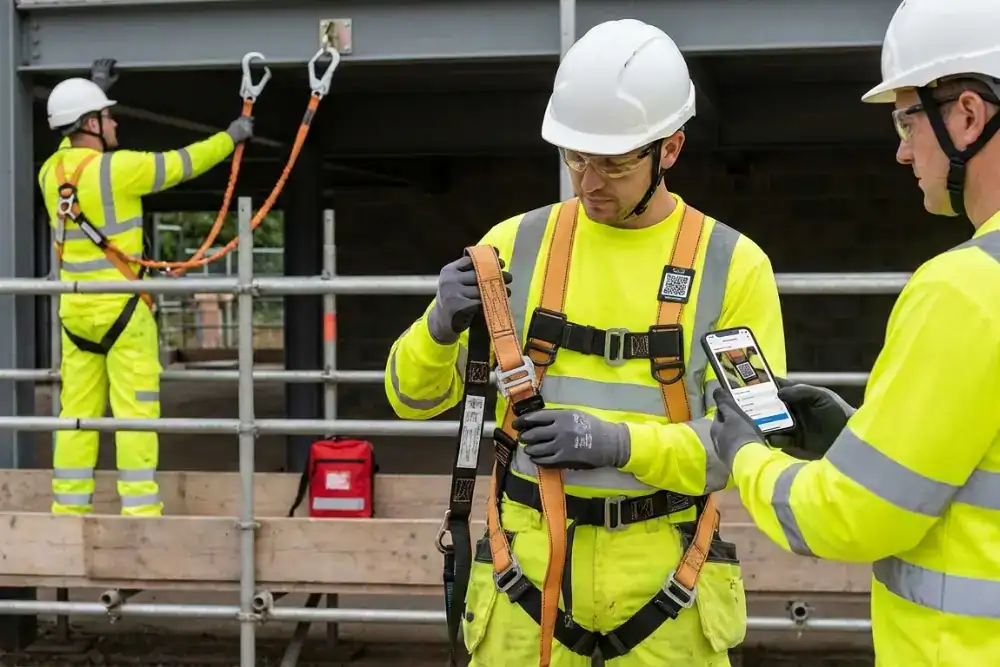
A robust inspection regime is essential. UK guidance requires pre-use checks, periodic detailed inspections by a competent person (typically every six months, or more frequently in harsh environments like chemical plants), and clear record-keeping. Increasingly, organisations use digital systems to schedule inspections, verify they are completed, and attach photographic evidence to each check.
Supervision plays a critical role. Supervisors must verify that the SSoW remains practical, identify drift from the planned method, spot incorrect adjustments, respond rapidly to issues, and support workers in pausing or stopping work when safe connection becomes difficult.
Finally, harness use cannot be considered in isolation. It must be coordinated with system verification and rescue planning. If rescue is not feasible, the system cannot be considered safe.
6. Worker Participation Strengthens Safe Work-as-Done
Worker involvement is central to achieving reliable harness use. When workers participate in shaping the method of work, equipment selection and daily safety routines, they reveal practical constraints and usability issues that risk assessments alone cannot capture.
This involvement should begin during equipment trials and task design and continue throughout the job. Workers can identify where anchor points are hard to reach, where harness straps loosen during movement, where tools interfere with lanyards, or where transitions feel unstable. These insights allow organisations to adjust equipment, redesign tasks or adapt the SSoW to support safer methods.
Participation also means creating an environment where workers can raise concerns, report defects, challenge impractical methods and request changes without fear of blame. This collaborative approach shifts safety from a set of rules into a shared responsibility grounded in operational reality.
Conclusion — Harness Use Depends on the System, Not Just the Individual
Correct harness use rarely fails because of a single factor. It emerges from the interaction between equipment design, task demands, usability, competence, supervision and the worker’s experience of risk. When organisations design systems that account for these realities, safety becomes intrinsic to the way work is carried out.
Harnesses protect workers only when the conditions for correct use are built into the job, through thoughtful planning, appropriate equipment selection, robust inspection regimes, competent supervision, and open participation from the people doing the work. When these foundations are in place, safe harness use becomes consistent, resilient and reliable.
Human Focus supports organisations in building these foundations.
Our fall-arrest and harness-inspection training programme helps develop competence and confidence. Our digital inspection system (using QR-tagged equipment, mobile inspection workflows and photographic evidence) provides a reliable, auditable framework for scheduling, verifying and managing harness and lanyard inspections. Together, these tools help organisations turn safe harness use from an expectation into an everyday practice grounded in real work.