A face fit test pass often becomes a belief that respiratory protection is “sorted” — even though the test only confirms fit under controlled conditions, not reliability in real work. Many organisations are surprised when “passed” masks fail in use, because the test outcome is treated as a control, rather than as one step within a wider RPE system.
When face fit testing is treated as a one-off compliance event, it can create false confidence rather than sustained protection. A fit test does not measure whether the same seal will be achieved repeatedly, under time pressure, or after weeks of reuse.
In practice, most face fit test failures are not caused by individual error, but by system conditions that make a reliable seal difficult to achieve or maintain. Face fit testing works best when it is treated as a signal about programme reliability — not as proof that the risk has been controlled.
This article explains the common reasons fit tests fail, then groups them into four programme failure modes so you can see where reliability breaks and what has to be controlled to keep the seal stable in day-to-day use.
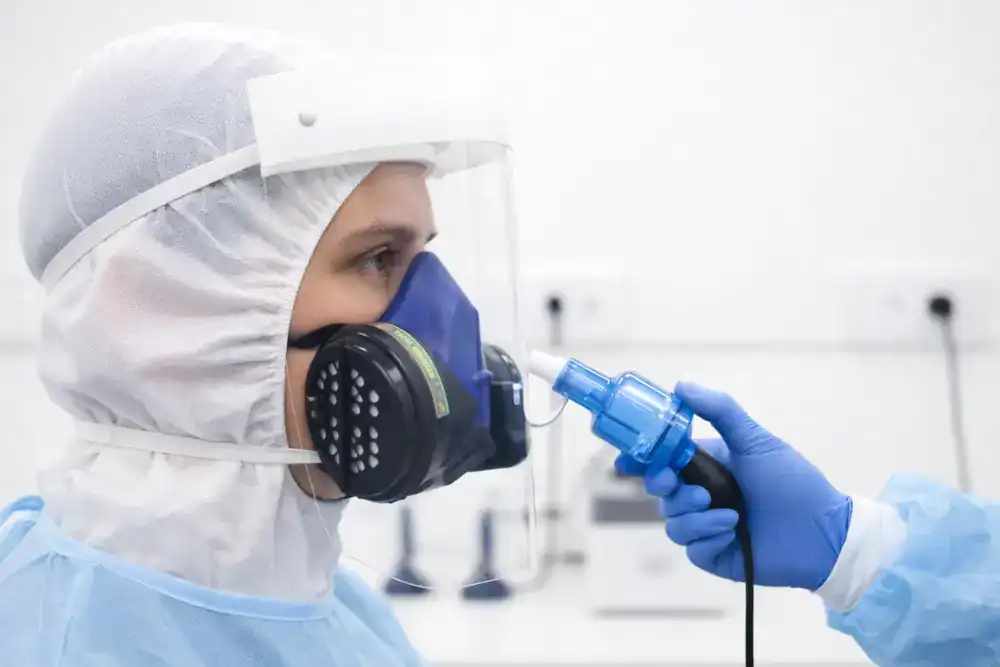
A face fit test checks how well a particular mask seals to one person’s face. It does not test the mask’s build quality or filter performance.
Instead, it looks at whether air can leak in around the edges during normal use.
The Health and Safety Executive (HSE) requires face fit testing for all tight-fitting respiratory protective equipment. This includes disposable masks, half-mask respirators and full-face respirators.
The test must be carried out before first use and repeated when changes occur that could affect fit. These changes may include facial hair growth, weight change, dental work or switching to a different mask model.
Yes, failing a face fit test is possible and fairly common.
A failure means the mask has not formed an adequate seal against the face. This allows contaminated air to bypass the filter and enter the lungs.
A failed test does not mean the wearer cannot use respiratory protection. It means that the specific mask tested is not suitable in its current form or fit.
Failing the test serves an important safety purpose. It prevents workers from relying on equipment that does not protect them properly. Once the reason for failure is identified, corrective action can be taken before the mask is used in a hazardous environment.
Failing a face fit test indicates that RPE is not providing the level of protection it is designed to deliver. Without an effective seal, hazardous substances such as dust, fumes, vapours or biological agents can be inhaled, increasing the risk of short- and long-term health effects.
From a legal perspective, using tight-fitting RPE that has failed a face fit test for that wearer may breach legal duties where a tight-fitting seal is required.
Under the Control of Substances Hazardous to Health Regulations 2002 (COSHH), employers must prevent or adequately control exposure to hazardous substances. Where tight-fitting RPE is used, the Personal Protective Equipment at Work Regulations 1992 require it to be suitable, properly fitted and effective for the wearer.
HSE sets out its expectations through published guidance. INDG479 – Fit testing of respiratory protective equipment (RPE) explains when fit testing is required, how it should be carried out and the competence required of fit testers. In addition, HSG53 – Respiratory Protective Equipment at Work provides broader guidance on the correct selection, use, maintenance and management of RPE, making clear that face fit testing is essential for all tight-fitting respirators.
Face fit testing protects workers by identifying problems before exposure occurs, ensuring RPE provides genuine protection rather than a false sense of security.
Many organisations understand they must conduct face fit tests, but workers still lose the seal in day-to-day use.
Yost, Downey and Samet (2022) argue that respiratory protection needs to be managed as a programme rather than treated as a single event.
A fit test is only one part of a respiratory protection programme. It shows that one make, model and size can seal on one person in a controlled setting. The test does not guarantee the seal will hold during the actual task.
Most repeat failures sit in four reliability failure modes:
- Availability failure happens when the fit-tested model is not what gets issued on the day.
- Repeatability failure happens when the seal varies across donning, time, and reuse.
- Compatibility failure happens when other PPE, skin products, and task conditions interact with the seal.
- Standardisation failure occurs when test methods, equipment setups, and tester competence vary across sites, making results non-comparable.
Most teams treat a pass as proof that the risk is controlled. The problem is that the pass is a snapshot. Protection is a system outcome.
HSE and NIOSH both frame fit testing as one control step inside a wider RPE and respiratory protection approach, and the result only applies to the specific make/model/size tested.
The pattern usually looks like this:
- The programme counts “% fit tested” as success.
- The organisation assumes the seal will hold in normal work.
- Local workarounds appear (speed, discomfort, substitutions).
- The first real signal is a repeat failure, an exposure concern, or an incident review.
At scale, consistency matters. If the test method varies by provider, site, or equipment setup, the organisation does not have one standard. It has local versions of “passing.”
HSE RR1222 found that sampling port location (flush vs extended) changes measured fit factors. The flush port produced fit factor results that were, on average, 16–17% higher. That difference is small until results sit close to the pass/fail threshold, where it can create a false pass.
The pattern usually looks like this:
- One site’s “pass” is another site’s “borderline.”
- Borderline results are treated as equal to strong results.
- The organisation cannot compare results cleanly across locations.
This is an availability failure. The fit-tested model is not consistently available, so substitutions become routine and the fit test result stops being operationally meaningful.
Procurement-driven range reduction is a common root cause. Tight-fitting respirators are not interchangeable. Each model has its own seal geometry, strap or harness design, and face seal stiffness.
When the approved list is too narrow, wearers are pushed toward what is on hand, even when the design is not compatible with their face. The outcome is predictable. Some people are effectively being tested in a facepiece that will not hold a reliable seal during normal movement and speech.
To keep the control credible, workers need access to alternative facepiece designs within the same protection class, not just another size of the same design.
This is a repeatability failure. If the seal changes with how the respirator is donned, the fit outcome is telling you the control is unstable, not that people simply need reminders.
Campbell et al. show that a fit test result can depend on the single time the respirator is put on. If you test after one donning, you can get false failures and false passes.
That happens because the seal is not fixed. Strap placement, strap tension, and nose clip shaping can change from one donning to the next. A person may fail because they achieved a poor seal on that attempt, even though they could pass with a better don. A person may pass because they achieved an unusually good seal on that attempt, even though their typical donning would not hold up.
Organisations need a process that makes correct donning consistent, so the seal achieved at the point of use matches the seal assumed by the test.
This is also a repeatability failure. The programme is relying on the seal holding across repeated donnings and time in use, not just during a single controlled test.
Respirator reuse can undermine fit because the seal can weaken with repeated on-and-off cycles. In these cases, the variable is not the wearer’s face but the respirator’s condition and performance after repeated use.
Bergman et al. tested what happens when people repeatedly put on and take off the same N95 respirator. They found that the fit did not stay stable. As the number of donnings increased, the proportion of tests meeting the pass threshold fell, and the effect differed by model.
In other words, reuse can turn a “good fit” respirator into an unreliable one. A mask can pass early in a sequence, then fail later, even with the same wearer, because repeated donning changes how the respirator sits and seals over time. Fit testing then detects a loss of seal as a fail.
This is a compatibility failure. The seal is being affected by interfaces and conditions that the test does not fully recreate.
A tight-fitting respirator only works if the face seal sits flat against the skin. Anything that sits under the seal, pushes on it, or changes the skin surface can create a leak path.
That is why HSE considers the introduction or change in other head-worn PPE as a reason to repeat fit testing. If you add different eyewear, a visor, helmet straps, or a headset after someone has passed, you may change the fit.
If anything may interfere with the facial seal (for example, jewellery, facial make-up, gels or creams), it should be present during the fit test to prove compatibility.
Skin protectants are a concrete example of how “work conditions” can flip a result. Bergman et al. found that fit factor depended on both the respirator model and the protectant type, with some protectants reducing fit more than others.
This is a compatibility and role design problem. If the job requires a tight-fitting seal, the organisation needs a workable decision on suitability, not a rule routinely traded away.
Facial hair under the sealing surface prevents a reliable seal, leading to an unstable or failing fit. HSE explicitly states that stubble and beards stop tight-fitting masks from sealing properly.
Repeat failures persist when the organisation treats this as a preference issue. It is a control decision about whether the role can be managed to a clean-shaven standard. HSE requires tight-fitting facepieces to be worn with the face clean-shaven.
Where workers have beards or cannot be clean-shaven, a tight-fitting device is not suitable and a loose-fitting option should be selected.
This amplifies all four failure modes. When teams are under time pressure or short-staffed, they default to whatever is available and quickest. That is exactly when seal-critical steps get dropped.
RPE controls tend to fail through gradual drift rather than a lack of awareness. “Normalisation of deviance” describes how small shortcuts become accepted because nothing immediately goes wrong.
In respiratory protection, that drift looks like:
- Allowing stubble.
- Putting on masks quickly.
- Skipping the check.
- Using “close enough” substitutes when the fit-tested model is not available.
Over time, the programme still exists on paper, but the seal is no longer being controlled in day-to-day work.
Hollnagel’s work-as-imagined versus work-as-done explains why this persists in organisations that “know the rules.” Procedures assume stable time, attention, and equipment. Real work forces trade-offs.
If fit-critical steps are not built into the job through availability, planning, and supervision, behavioural drift can lead to repeat face fit failures.
Training improves how tests are conducted, but training alone does not hold the seal during real tasks — system design does. If the fit-tested model is not consistently available, or substitutes are routinely issued, the face fit test result quickly loses meaning.
When fit outcomes vary between tests or over time, this should be treated as evidence of an unstable control, not simply a competence gap. Differences in fit testing method, equipment, or tester competence across sites can produce inconsistent assurance, even when paperwork appears complete.
Effective face fit testing programmes focus less on “passing rates” and more on repeatability, traceability, and control of change. Support, tools, and training should therefore be aimed at maintaining programme reliability over time — not at implying that fit testing removes the risk.