

About Human Focus
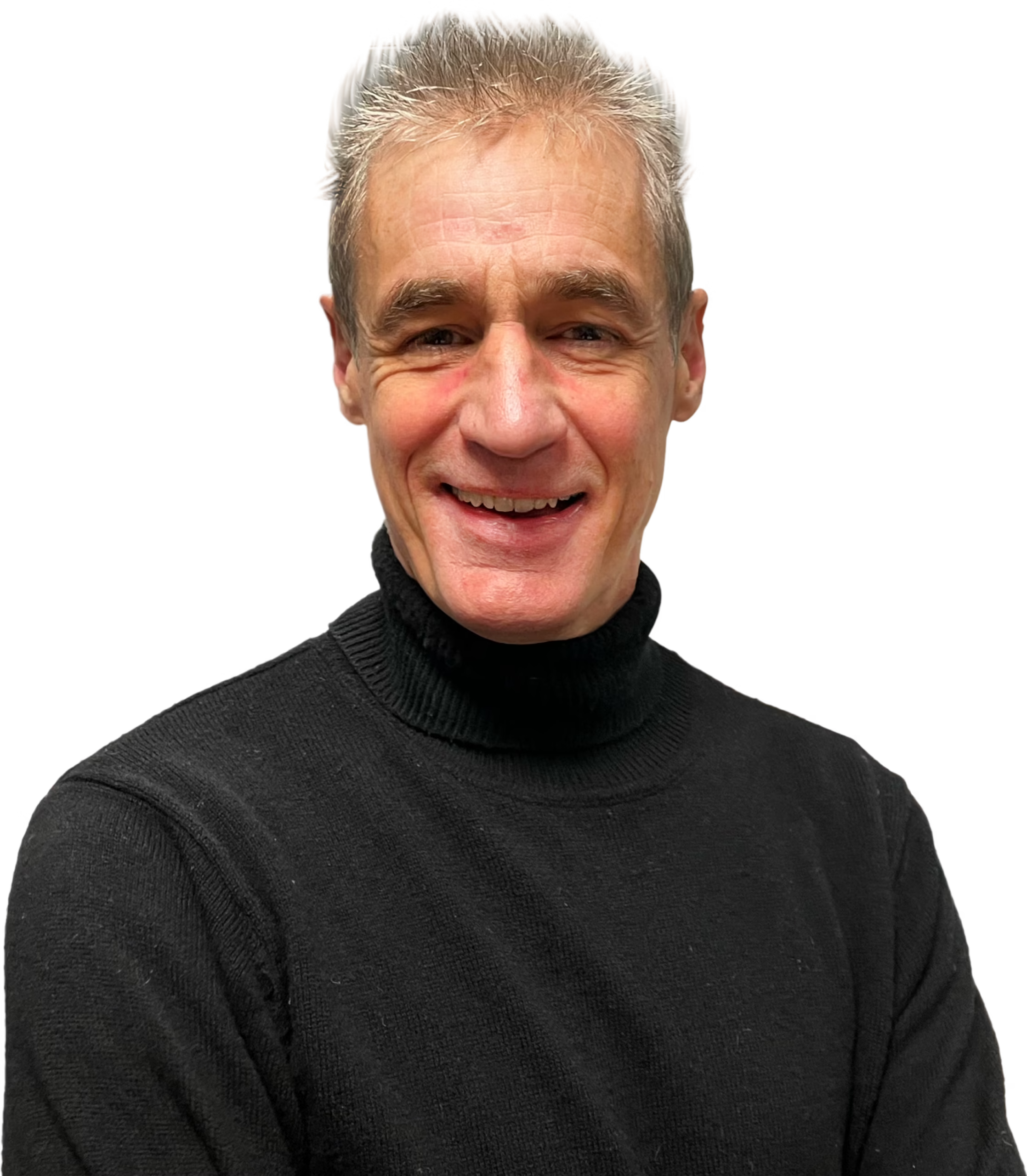
I started Human Focus in 1992 from the spare bedroom of my flat in South West London, with my wife Tracey beside me, and a strong belief that has stayed with me ever since.
At the time, I was a young human factors specialist. I knew a lot about ergonomics and human factors in theory, but I still had a great deal to learn about the real world of health and safety — the world of production pressures, imperfect systems, experienced workers, changing conditions and risk that has to be managed at the point where people can actually get hurt.
This is where the journey of Human Focus began.
From the beginning, the name mattered to me. Human Focus was an idea that safety does not improve simply because an organisation writes more procedures, delivers more training or completes more audits. These things are necessary, but they are not enough.
Safety improves when we understand how people really work, how they make decisions, how they adapt, how they use their experience, and how we can help them control risk in the situations they actually face.
The Question That Shaped Human Focus
One of the most important influences on my thinking was Dr Hani Raafat, who I met in the early 1990s. Hani was a lecturer at Aston University on the Health and Safety Master’s course, an international expert, and someone who trained many of the UK Health & Safety Executive field inspectors, as well as many health and safety practitioners working in industry.
He was also an engineer, which mattered. His thinking was never abstract or academic for its own sake. It was practical, grounded and focused on how safety could be made to work in the real world.
To me, Hani was a guru — my Obi-Wan Kenobi. He helped me understand and focus relentlessly on the question:
“How do we help people work safely at the point of harm?”
That question from Hani has shaped my working life and is the mission of Human Focus.
Our Mission
Over the years, I have become more and more convinced that good systems, safe equipment, clear procedures and proper training are essential — but they will never be the complete picture. Real work is always more complex than the plan. Conditions change. Priorities compete. Information is incomplete. People have to notice, judge, communicate, adapt and act.
In other words, people are not just a source of error. They are a vital source of safety.
Human Focus exists to help organisations build that capability. We help clients move beyond paper-safe compliance and develop genuine safety competency — at the level of individuals, teams and the organisation as a whole.
This is especially important where the potential consequences are serious. Minor injury prevention and general compliance activity matter, but serious accidents often follow different pathways. Preventing serious harm requires a deeper understanding of how critical risks are actually controlled, where those controls are vulnerable, and what people need to know and do when things are not straightforward.
That is why so much of our work is focused on learning from work as done.
Developing and Harnessing Resident Expertise
In every organisation, there is a great deal of safety knowledge already present. It sits with experienced people close to the work — supervisors, operators, engineers, contractors, maintenance teams and others who understand where procedures fit reality and where they do not.
They know which controls really matter. They know where things can go wrong. They know what new starters need to learn but are often never formally taught.
One of the things Human Focus does is help organisations capture this resident expertise and turn it into practical improvements — better training, clearer procedures, stronger supervision, more useful safety conversations and more effective control of critical risks.
A Safety Competency Service, Supported by Software
Technology has always been part of our story. We began by producing VHS safety training programmes sent out by mail order. Then came DVDs. In 2000 we moved online and became one of the first providers of online health and safety training as a service — what is now called software as a service, or SaaS.
Today, we deliver our own online safety competency system — software we have developed, maintained and continually improved for more than a quarter of a century. It helps organisations deliver learning, manage work, apply controls, capture feedback and improve performance.
But the online system is not the whole answer. It is a way of delivering the mission.
We think of Human Focus as a service with software. That order matters.
We are not interested in chasing technology trends, selling generic software or adding more safety activity for its own sake. Our focus is on what helps organisations build genuine safety competency, control critical risks and improve how work is actually carried out.
That requires more than technology. It requires a multidisciplinary service capability that brings together health and safety expertise, human factors, learning design, content development, compliance knowledge, learning needs analysis, software development and technical delivery.
That is what we have built: an integrated team of advisors, consultants, learning specialists, content developers, designers and technical experts who can deliver a service — supported by software — that helps clients build safety competency in practice.
I am particularly proud of the Human Focus team. Many of our people have been with the company for more than a decade. I have seen colleagues grow, develop, deepen their expertise and take real pride in the work we do. That has been one of the most rewarding parts of the whole journey.
It amazes me that today Human Focus operates around the world with a team of more than 100 people. That is not something I take for granted. It has been built patiently, over many years, by colleagues who care deeply about their work and the difference it makes.
Alongside our online system and remote support, we also provide onsite consultancy, face-to-face training, practical implementation support and advisory services. This work is often in higher-risk and safety-critical environments, and extends to workplaces around the world — including Africa, Europe and North America.
This is an important part of what makes Human Focus different. We are not simply providing access to software. We have people with the expertise to work with clients directly, understand their risks, support their teams and help them apply safety competency in real operational settings.
Many organisations that come to us for consultancy support have the basics in place. They have training records, procedures and audit trails. With our extended consultancy support, we are able to build confidence that their people who are closest to the risk know what to do when things don’t go to plan. It’s a critical gap we help close.
Staying Close to Real Work
The practical work we undertake with our clients keeps us close to their safety realities, the risks and implementation challenges. It helps us keep improving our online system, our training, our consultancy and the support we provide.
I am very proud that our team is helping clients in these environments make a real difference to the safety of people working at the point of significant harm. That is what continues to motivate me.
Our clients are not simply buying access to a platform or a library of courses. They are working with a team that understands safety competency and how to achieve it in practice.
That means taking the time to understand the client’s risks, workforce, operating environment and existing ways of working — then shaping the system, content, consultancy, training and support around what will actually help.
Because the online system is our own, we can mould and adjust it to meet the needs of individual clients. And because our people have worked together for many years, with a deep understanding of health and safety needs, we can provide a level of service that is difficult to replicate.
We spend time getting to know our clients. We form long-term relationships. We listen, adapt and develop solutions that work for their risks, their people and their operating environment.
It is this combination — our own online system, our integrated team, our onsite experience and our commitment to long-term client service — that really makes the difference.
Why This Still Matters to Me
I am now in my early 60s. I am privileged that I do not need to be doing this in the ordinary sense of the word. I am here because I still believe, very deeply, that Human Focus can make a positive difference to safety.
For me, this is not just a job. It is a vocation.
And, perhaps strangely after all these years, I feel more energised, more excited and more committed to this work than ever. We are starting to get really good at something we have been working on for more than 40 years. It feels like an overnight success that has taken a lifetime to build.
Human Focus remains privately owned and founder-led. That matters because our purpose is not to chase fashion, sell generic software or add more safety activity for its own sake. Our purpose is to help organisations improve safety where it matters most — in the work itself.
The clients who get the most from Human Focus are those who want safety to be more than a record of compliance. They want to understand how work is really done. They want to involve the people closest to the risk. They want to strengthen competence, improve control of critical risks and build systems that support people rather than simply instruct them.
That is the kind of organisation we exist to help.
Human Focus was founded on a simple belief: safety improves when we focus on people, work and risk as they really are.
That belief is stronger in me now than it has ever been.

