


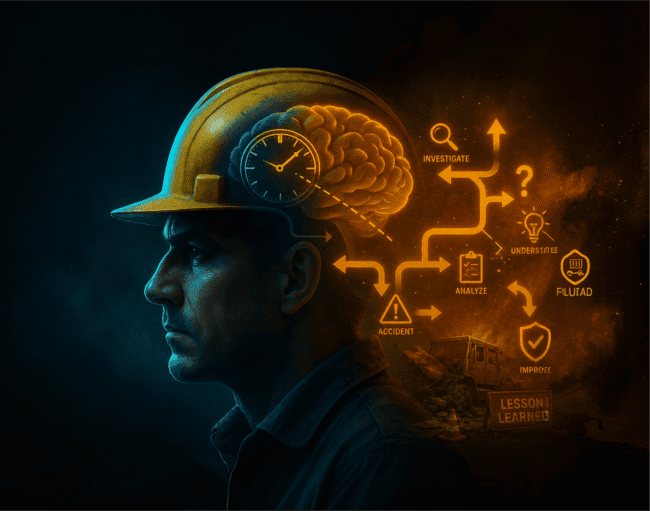

Free-orange (1)

Why Accident Investigations

Fail to Learn

Common barriers to organisational learning — and how to overcome them

accidents fail to learn
Ian Pemberton-webinar by human focus

Presented by
Ian Pemberton
Chartered Ergonomist, C. ErgHF, MCHIEHF
Managing Director, Human Focus

Your investigations are producing findings. But are they producing the depth of learning needed to prevent recurrence?

Most organisations do learn from incidents. Investigations often produce useful insights, sensible recommendations and genuine improvements. But similar events still recur. The same themes appear in findings. Actions get implemented. And then, in a slightly different form, it happens again.

So the issue is not whether investigations produce learning. They usually do. The more important question is whether that learning goes far enough.

This recorded webinar explores why many investigations stop short of the deeper learning available — not because people lack effort or commitment, but because of the questions we are taught to ask, the frameworks we use, and the assumptions baked into both.

In this recorded webinar, Ian Pemberton draws on real-world case studies to show why investigations so often miss important parts of the story — and what a more complete approach looks like in practice.

Crucially, this isn’t about starting over. The foundations of traditional safety investigation remain valuable. The task is to build on them — adding the Human Factors perspective that reveals what existing methods can leave out, including what we can learn from how work succeeds, not just how it fails.


Does This Sound Familiar?

  • Similar incidents keep recurring. You investigate, you act — and then a comparable event happens again. Particularly at the higher-risk end.
  • You can’t get to the bottom of why people did what they did. Reports describe what happened, but fail to explain the reasoning, pressures, uncertainty and context behind the decisions people made.
  • The investigation focuses heavily on the visible workplace “stuff”. Equipment, procedures, signage, physical conditions and documented controls are examined in detail — but far less attention is given to what was going on in people’s heads: what they noticed, misunderstood, anticipated, prioritised or assumed.
  • A nagging sense that outcomes aren’t addressing the underlying system conditions. Recommendations focus on procedures, retraining and equipment — but important questions about context, pressure, decision-making, expertise and the way work is organised remain unresolved.
  • You know there is a next level to investigation — but it is unclear how to get there. There is a growing recognition that current approaches have a ceiling, and that getting beyond it requires a different way of thinking.

If these resonate, this recorded webinar provides a practical framework and supporting evidence to help you move forward.

What You Learn in This Recorded Webinar

Human Factors specialist Ian Pemberton uses real-world case studies to illustrate the principles behind more effective investigation and learning — covering four interconnected themes.

1. The Investigator’s Mindset Shapes What Gets Learned

Every investigation is shaped by the mental model of the investigator. What they think accidents are determines what they look for, what questions they ask, what evidence they select, and what they eventually conclude.

Traditional approaches are often built on a linear, cause-and-effect view of the world: trace the chain of events back to a root cause, fix it, close the file.

This model has genuine strengths — particularly for technology, equipment and physical systems. But applied to the complex, human realities of modern workplaces, it has critical blind spots.

One of those blind spots is a strong bias toward what can be seen, measured and documented: the workplace layout, the machine, the procedure, the permit, the barrier, the PPE, the training record. These are important, but they are only part of the story.

What is often missing is the cognitive story: what people understood, where their attention was, what cues they were responding to, what they expected to happen, what competing goals they were balancing, and how their expertise shaped their actions.

Recognising those blind spots is where better learning begins.

2. Human Error Is a Label, Not an Explanation

Many investigations identify human error as the cause and then focus on preventing that error from happening again. Locally, this can make sense. It may lead to useful actions: clearer procedures, better training, improved supervision, redesigned equipment, or stronger checks.

But as a broader learning strategy, it is limited — and can sometimes be counterproductive.

When the investigation stops at the error, it can miss the wider conditions that made the error more likely, more understandable, or harder to detect and recover from. It can also miss learning that has relevance far beyond the specific incident: how work is organised, how pressure is managed, how expertise is used, how information flows, and how people make sense of situations under uncertainty.

Human error is a symptom, not a cause. People make decisions that make complete sense to them given what they knew, what they noticed, what they expected, what pressures they faced, what trade-offs they were managing, and what had worked before.

Until investigations uncover that context — the local rationality of those involved — much of the deeper learning remains hidden.

In this recorded webinar, you’ll learn how better investigation questions can reveal the decision-making, uncertainty, workload, communication, expertise and system pressures that sit behind the label of human error.

3. Learning From Success, Not Just Failure

Work succeeds far more often than it fails — and that success is not accidental.

Operators are constantly making intelligent adaptations: managing trade-offs, filling gaps in procedures, resolving conflicts between goals, and drawing on experience to keep systems running safely.

Much of this adaptive work is cognitive. People notice weak signals, anticipate problems, recognise patterns, make sense of incomplete information, coordinate with others, and apply hard-won expertise to situations that procedures cannot fully specify.

Traditional investigations often miss this. They examine the failed outcome, but not the expertise and adaptive performance that normally prevent failure.

A more powerful approach treats everyday successful performance as a source of learning — understanding the adaptations that usually work, the expertise those adaptations depend on, and the conditions that support or undermine them.

This also means recognising that what gets labelled a violation in the wake of an incident may have been routine, effective behaviour the day before.

4. A More Complete Investigation — Built on What Works

The answer is not to discard traditional safety investigation. It is to add to it — integrating the cognitive, social and adaptive dimensions of work that conventional approaches often miss.

That means understanding what people understood at the time, what information they had, what cues they noticed, what assumptions they made, what decisions they faced, how they communicated, how teams maintained the big picture, and how the system shaped their choices.

It also means exploring the role of expertise: how experienced people recognise patterns, adapt to variability, manage competing demands and keep work safe in conditions that are rarely as simple as the procedure imagines.

Through case studies, Ian shows what this looks like in practice — and what it takes in terms of investigator mindset, interview technique and analytical framework to make it real.

Why Watch

You’ll leave this recorded webinar with:

  • A clear understanding of why investigations often fall short of their full learning potential — and the mindset shifts needed to change that.
  • Insight into why human error as a conclusion can close down learning rather than enabling it.
  • A practical way to uncover local rationality: why actions made sense to people at the time.
  • A better understanding of how to investigate the cognitive dimensions of work — including attention, sensemaking, uncertainty, anticipation and decision-making.
  • An appreciation of the role expertise plays in successful adaptive performance.
  • An understanding of how learning from successful work — not just failures — transforms what investigations can achieve.
  • Real-world examples of what a more complete, Human Factors-informed investigation looks like.
  • Better questions for exploring decision-making, trade-offs, communication, team dynamics and the conditions that shape performance.
  • A practical framework you can begin applying immediately — one that builds on your existing approach rather than replacing it.

Presented by: Ian Pemberton

Chartered Ergonomist, Human Factors Specialist, and leading authority on workplace safety performance and system design.

With over 30 years of experience, Ian has helped organisations across industries rethink how safety is supported — designing systems that align with real work and strengthen decision-making where it matters most.

Drawing on Cognitive Systems Engineering and Resilience Engineering, Ian brings practical, evidence-based insight into how organisations can move beyond compliance-driven safety toward systems that are both robust and genuinely capable of learning.

Ian Pemberton-webinar by human focus